• Welcome to Baptist Board, a friendly forum to discuss the Baptist Faith in a friendly surrounding.

    Your voice is missing! You will need to register to get access to all the features that our community has to offer.

    We hope to see you as a part of our community soon and God Bless!

WHO IS THE SON OF GOD?

David Lamb

Well-Known Member
Jn 1:1c is not talking about Jesus, but his heavenly persona.
Yet John goes on to write:

(Joh 1:14 NKJV) And the Word became flesh and dwelt among us, and we beheld His glory, the glory as of the only begotten of the Father, full of grace and truth.

The One Who "became flesh", and dwelt among John and his fellow disciples, and Whose glory they beheld, was the same "Word" as mentioned in John 1:1-3:

(Joh 1:1 NKJV) In the beginning was the Word, and the Word was with God, and the Word was God.
(Joh 1:2) He was in the beginning with God.
(Joh 1:3) All things were made through Him, and without Him nothing was made that was made.
 

Martin Marprelate

Well-Known Member
Site Supporter
I have always felt that the simplest way to illustrate the two natures of Christ is found in the account of the Stilling of the Storm (Mark 4:35-41 etc.).
When the Lord Jesus comes onto the boat, He goes to sleep on a cushion. Why does He do that? Because He is tired. He is a Man; Man as though He were not God. Elsewhere, He is hungry, thirsty and sad enough to weep. He is true Man.
But when the storm arises, and the disciples come to Him in great fear and wake Him, He stills the storm with a word. He does not pray to the Father to still it for Him; He Himself stills the storm. Who else can do that save Almighty God? He is God; God as though He were not Man. He is true God.

What does the Chalcedonian Creed say? 'We all, with one voice, confess our Lord Jesus Christ, one and the same Son, at once complete in deity and complete in humanity, truly God and truly Man.....One and the same Christ, Lord, only-begotten, to be acknowledged in two natures, without confusion, without change, without division, without separation; the distinction of the natures being in no way abolished because of the union, but rather the characteristic property of each nature being preserved, and coming together to form one Person and one hypostasis. He is not split or divided into two Persons, but He is one and the same Son and only-begotten, God the Logos, the Lord Jesus Christ, as formerly the prophets and later Jesus Christ Himself have taught us about Him, and as it has been handed down to us by the Creed of the Fathers.'
 
I have always felt that the simplest way to illustrate the two natures of Christ is found in the account of the Stilling of the Storm (Mark 4:35-41 etc.).
When the Lord Jesus comes onto the boat, He goes to sleep on a cushion. Why does He do that? Because He is tired. He is a Man; Man as though He were not God. Elsewhere, He is hungry, thirsty and sad enough to weep. He is true Man.
But when the storm arises, and the disciples come to Him in great fear and wake Him, He stills the storm with a word. He does not pray to the Father to still it for Him; He Himself stills the storm. Who else can do that save Almighty God? He is God; God as though He were not Man. ...
Yes, there are, in scripture, many such places, as the example you gave (wonderful by the way in its perfect description, scripturally speaking), and such demonstrate the truth of the matter, to those willing to be under subjection to the Holy Ghost / Spirit will accept it / them, but those who refuse in their pride, will never accept that answer.
 
As for Luke 2:33, I accept Metzger, who says "His father and mother" was the original reading. I am frankly not interested in the rantings of KJV onlyists.
What a waste of time this is. Nothing but red-herrings, distractions, non-sequiturs from your responses.

What you 'accept' is not the foundation of truth. What "Metzger" says is also not the foundation of truth, either.

In agreement with KJB:
  • A, E, G, H, K, M, S, U, Y, X, Gamma, Delta, Theta, Lambda, Pi, Psi, 053
  • Cursives: MAJORITY, fam 13
  • Old Latin: a, aur, b, beta, c, e, f, ff2, [page 86-87] g1, l, q, (r1)
  • Syr: pesh, harc, pal-ms
  • Cop: bo-pt
  • Goth
  • Also extant in: Y, Xi, Omega, 045, 055, 0130, 0211, 0233? Here and in 2:43 the virgin birth is clearly deminished.
In alignment with NIV:
  • Aleph, B, D, L, W
  • Cursives: pc, fam 1
  • Old Latin: d, g2, Vulg [page 86-87]
  • Syr: sin, harc-mg
  • Cop: sa, bo-pt
  • Arm, Eth - Cited in A Closer Look: Early Manuscripts & The AV (Jack Moorman); pages 86-87
ECF in agreement with KJB:
  • TATIAN, Diatessaron (I 10:46)
ECF in alignment with NIV:
  • CYRIL OF JER., Cat. Lectures (III 7:46) - Cited from Early Church Fathers And The Authorized Version (Jack Moorman); page 45
  • "... Textus Receptus - Traditional Text
    • καὶ ἦν Ἰωσὴφ καὶ ἡ μήτηρ αὐτοῦ θαυμάζοντες ἐπὶ τοῖς λαλουμένοις περὶ αὐτοῦ.
  • Hort-Westcott - Critical Text
    • καὶ ἦν ὁ πατὴρ αὐτοῦ καὶ ἡ μήτηρ θαυμάζοντες ἐπὶ τοῖς λαλουμένοις περὶ αὐτοῦ.
  • Corrupted Manuscripts
  • This verse is corrupted in the following manuscripts:
    • Aleph 01 - Sinaiticus - Nineteenth Century Counterfeit
    • B 03 - Vaticanus - Fourth century
    • D 05 - Bezae Cantabrigiensis - Fifth century
    • L 019 - Seventh century
    • W 032 - Fourth/fifth century
    • 1 (Minuscule) - Seventh century
    • 700 - (Minuscule) Eleventh century
  • Manuscripts which agree with the Textus Receptus for this verse
    • Byzantine Text (450-1450 A.D.)
    • A 02 - Alexandrinus - Fifth century
    • K 017 - Ninth century
    • X 033 - Tenth century
    • Gamma 036 - Ninth or Tenth century
    • Delta 037 - Ninth century
    • Theta 038 - Ninth century
    • 13 (Minuscule) - Eighth century
    • 28 (Minuscule) - Eleventh century
    • 565 - (Minuscule) - Ninth century
  • Published Critical Greek Texts with Corruptions
  • Reads “his father” instead of “Joseph”
    • Greisbach, Johann - 1805
    • Tischendorf, Constantine - 1869
    • Tregelles, Samuel - 1857
    • Alford, Henry - 1849 revised in 1871
    • Westcott and Hort - 1881
    • Weiss, Bernhard - 1894
    • Nestle - 1927 as revised in seventeenth edition in 1941
    • Nestle-Aland - 1979 - Twenty Sixth Edition
    • Nestle-Aland - 1993 - Twenty Seventh Edition
    • United Bible Societies - 1983 - Fourth Edition
    • Von Soden, Freiherr - 1902 ..."
  • "... Affected Teaching
    • If you notice something about each of these modern versions, they change “Joseph” to “father.” These modern versions have complete agreement with the Roman Catholic and Jehovah’s Witness Bibles. In the Textus Receptus, the proper name Joseph is written but in the HW Greek, the term was changed to “father” which comes from the Sinaiticus manuscript. ... In the second century, a heretic named Marcion disqualified Matthew, Mark, and John as being legitimate gospels and held only that Luke was authentic. However, he tended to make changes in the book of Luke to fit his Gnostic beliefs and may have been the one who changed the text from “Ἰωσὴφ” (Joseph) to “πατὴρ” (father).
  • Nevertheless, whoever changed it, it remained that way for sixteen hundred years, resurrected in the 19th century, and has been accepted by unbelieving modern scholarship and given credence by Christians who use these modern versions without doing any investigation of the version they use. When trying to understand the subject of the corruption of the modern versions, you must understand it as thousands of small corruptions such as the one we just saw rather than a few large corruptions. If Satan used large and obvious corruptions, then Christians would not accept it but Satan knows that the easiest way to corrupt and derail Christianity is by subtlety through the back door. It is easier to make smaller encroachments through the back door than a major frontal assault. The NIV is the most corrupted of the modern versions yet is used by more Christians and churches than ever before. ..." - Luke 2:33

  • '... "Joseph and his mother" has been altered to "the child's father and mother" or "His father and mother" by the DR, RV, Ne, NIV, NKJV marg., RSV, GN, AMP, NASV, NEB, NWT, JB. LB refers to Joseph and Mary but does not attribute parenthood to either!
  • Ruckman (24) p 43, states that this passage reading is found in an 8th century manuscript, in two from the 9th century and one from the 10th century plus "nearly all" the Caesarian type texts and Old Latin witnesses. Fuller (4) p 220, indicates that the modern reading comes from Jerome, using the corrupt text (i.e. Aleph and B) of Eusebius. Berry's Greek text supports this passage. ..." - https://ecclesia.org/truth/manuscript_evidence.html
 
As for Luke 2:33, I accept Metzger, who says "His father and mother" was the original reading. I am frankly not interested in the rantings of KJV onlyists.
Continued...
  • "... Luke 2:33, 43 “JOSEPH and his mother marvelled” or “HIS FATHER and his mother marveled”?
  • In the true Bible God never refers to Joseph as “the father” of Jesus, and this is simply because when God became a man in the incarnation, the baby Jesus was born of the virgin Mary and His Father was God, not Joseph. Pretty simple truth, but even this truth is being messed with in many inferior bible versions.
  • In Luke 2:33 of the King James Bible we read - “And Joseph and his mother marvelled at those things which were spoken of him.”
  • Yet in such versions as the ESV, NIV, NASB, NET, Holman, all Catholic versions and the Jehovah Witness New World Translation we read: “And HIS FATHER and his mother marveled at what was said about him.”
  • This is a textual difference that definitely affects the theological meaning and significance regarding the Person of the Lord Jesus Christ and His nature as the Son of God and Son of man.
  • And again in Luke 2:43 in the KJB we read: “And when they had fulfilled the days, as they returned, the child Jesus tarried behind in Jerusalem; and JOSEPH AND HIS MOTHER knew not of it.”
  • Yet in versions like the ESV, NIV, NASV, NET, Holman, the Catholic versions and the Jehovah Witness NWT we read: “…the boy Jesus stayed behind in Jerusalem, and HIS PARENTS did not know it.”
  • The reading found in the King James Bible in Luke 2:33 - “Joseph and his mother” - is that of the Majority of all Greek manuscripts including A, E, G, H, K, M, S, U, Y, X, Xi, Gamma, Delta, Theta, Lambda, Pi, Psi and Omega.
  • It is also the reading of the Old Latin copies a, aur, b, beta, c, e, f, ff2, g1, l and q.
  • Likewise it is the reading found in the Syriac Peshitta, Harclean, some Coptic Boharic versions and the Gothic ancient translations. ..."
  • "... Whereas the reading of “his FATHER and mother” is that of Sinaiticus, Vaticanus, D, L and W, and the Latin Vulgate. Obviously God did NOT inspire both divergent readings in the same place. One is right and the other is not right. But in these days of Laodicean lukewarmness, apathy and indifference, in which the majority of professing Christians no longer believe that ANY Bible in ANY language is the complete and infallible words of God, 100% true and without error, few seem to care or be concerned about it.
  • The same holds true for the reading in Luke 2:43. Is it “JOSEPH AND HIS MOTHER knew not of it.” or “his PARENTS did not know it.”?
  • Again, the reading found in the KJB is that of the majority of all manuscripts, the Old Latin, and the Syriac Peshitta, Harclean, Gothic and Ethiopic ancient versions. Whereas “his PARENTS” is that of Sinaiticus, Vaticanus and a handful of others.
  • I primarily wish to deal with Luke 2:33 “Joseph and his mother” vs “his father and his mother”. I will get to the issue of “his parents” and what this word means in the latter part. ..."
  • "... Agreeing with the King James Bible in Luke 2:33 - “JOSEPH and his mother marvelled at those things which were spoken of him.” are the Bishops’ Bible 1568, the Geneva Bible 1582 - “And Ioseph and his mother marueiled at those things”, The Beza New Testament 1599, The Bill Bible 1671, Mace N.T. 1729, John Wesley’s Translation 1755, Worsley Version 1770, Thomas Haweis N.T. 1795, The Revised Translation 1815, Webster’s translation 1833, the Living Oracles 1835, The Morgan N.T. 1848, Etheridge Bible 1849, Murdock Translation 1852 and Lamsa’s 1933 translations of the Syriac - “And JOSEPH and his mother marvelled”, The Boothroyd Bible 1853, Julia Smith Translation 1855, The Revised N.T. 1862, Young’s literal 1898, NKJV 1982, KJV 21st Century 1994, Third Millennium Bible 1998, The Lawrie N.T. 1998, The Tomson N.T. 2002, Apostolic Bible Polyglot Greek 2003, Robinson-Pierpoint Byzantine Greek N.T., A Conservative Version Interlinear 2005, The Pickering N.T. 2005, The Resurrection Life N.T. 2005, Complete Apostle’s Bible 2005, English Jubilee Bible 2010, the Hebraic Transliteration Scripture 2010, Holy Scriptures VW Edition 2010 by Paul Becker, the Online Interlinear André de Mol 2010, The Aramaic N.T. 2011, World English Bible 2012, The Bond Slave Version 2012, the 2012 Natural Israelite Bible - “Joseph and his mother were marveling”, The Hebrew Names Version 2014 - "And Yosef and his mother...", The Modern Literal N.T. 2014 and The Modern English Version 2014.
  • This is also the reading of the Greek texts of Stephanus 1550, Beza 1598, Elziver and Scrivener - και ην ιωσηφ και η μητηρ αυτου θαυμαζοντες, as well as that of the Modern Greek Bible and the Modern Hebrew Bible as well - ויוסף ואמו תמהים על הדברים הנאמרים עליו׃ = “And Joseph and his mother were amazed at what was said of him.” ..."
  • "... Foreign language Bibles that follow the readings found in the King James Bible of “JOSEPH and his mother marvelled” (Luke 2:33) and “Joseph and his mother knew not” (Luke 2:43) are the Spanish Sagradas Escrituras 1569, Cipriano de Valera 1602, the Reina Valeras 1909 - 2011 - “ José y su madre estaban maravillados”, the German Schlachter Bible 2000, and the German Hoffnung fur Alle Bible 2002 - “Und Joseph und seine Mutter”, the French Martin 1744, French Ostervald 1998 and French Louis Segond 2007 - “Joseph et la mère étaient émerveillés”, the Italian Diodati 1649, La Nuova Diodati 1991 and La Bibbia della Giola 2006 - “ E Giuseppe e la madre del bambino si meravigliavano”, the Portuguese A Biblia Sagrada, Almeida Corregida 1681 and O Livro 2000 - “José e Maria admiravamse”.
  • Other foreign language Bibles that read like the KJB are the Hungarian Karoli Bible - “József pedig és az õ anyja”, the Russian Synodal Version - “Иосиф же и Матерь Его дивились сказанному о Нем”, the 1998 Tagalog Ang Salita ng Diyos Bible - “Si Jose at ang ina ni Jesus ay namangha “, the Afrikaans Bible 1953 - “En Josef en sy moeder”, the Dutch Staten Vertaling Bible - “En Jozef en Zijn moeder verwonderden”, the Smith & Van Dyke Arabic Bible - وكان يوسف وامه يتعجبان مما قيل فيه., the Czech BKR Bible - “Otec pak a matka jeho divili se těm věcem”, the Albanian Bible - “Dhe Jozefi e nëna e fëmijës mrrekulloheshin”, the Finnish Bible 1776 - “Ja Joseph ja hänen äitinsä ihmettelivät”, the Lithuanian Bible- “Juozapas ir Jėzaus motina”, and the 2014 Romanian Fidela Bible - “Și Iosif şi mama lui s-au minunat.” ..."
  • "... Those that read “HIS FATHER and his mother marvelled” are Wycliffe 1395 (from the Latin Vulgate), Tyndale 1534, Coverdale 1535, the Great Bible 1540, Matthew’s Bible 1549 (Thus we see the need for the purification of previous English bibles), Catholic Douay-Rheims 1582, the Revised Version 1881, ASV 1901, RSV, NRSV, ESV, NIV, NASB, NET, Holman, St. Joseph New American Bible 1970, New Jerusalem bible 1985 and the Jehovah Witness New World Translation.
  • The point is, God did not inspire both readings. One is the true one and one is not.
  • The Bible agnostics and those who do not believe in the inerrancy of ANY Bible in ANY language (including those never seen and non-existent originals) try to explain away the significance of these textual and theological differences by telling us - “Yeah, but look at the KJB in verse 2:27 where it says “THE PARENTS brought the child Jesus, to do for him after the custom of the law” and in Luke 2:41 it says “Now HIS PARENTS went to Jerusalem every year at the feast of the passover.” ‘See’, they tell us, ‘the KJB calls Joseph and Mary his PARENTS.’
  • Well, there IS a very legitimate way for God to refer to both Joseph and Mary as Jesus’s parents, but not for God to tell us that Joseph was his father. We will look at the meaning of the word “parents” in a moment.
  • Another objection the bible agnostics bring up is by pointing to Luke 2:48 where Mary says to Jesus “Son, why hast thou thus dealt with us? behold, THY FATHER and I have sought thee sorrowing.”
  • They tell us - “See, Mary refers to Joseph as Jesus’ father.” ..."
  • "... Well, Yes, she does. But not God. And Jesus seems to correct her mistaken view in the very next verse by saying - “How is it that ye sought me? wist ye not that I must be about MY FATHER’S business? And they understood not the saying which he spake unto them.”
  • Jesus is emphasizing the fact that His real Father is God, not Joseph. The point is, God never inspired a reading in His Book where HE refers to Joseph as Jesus’ “father”.
  • In Luke 3:23 we read the words of God relating: "And Jesus himself began to be about thirty years of age, BEING (AS WAS SUPPOSED) THE SON OF JOSEPH, which was the son of Heli," There is a world of difference between GOD telling us that it "was supposed" that Jesus was the son of Joseph, and GOD allegedly saying that Joseph was "his father". One statement is true; the other is not.
  • Now, for an explanation about the word “parents”. What does the word mean?
  • Parents -
  • Collins English Dictionary 1. a father or mother 2. a person acting as a father or mother; guardian
  • Dictionary.Com Parents = a father or a mother; a protector or guardian.
  • Cambridge Dictionary of American English - Parent - a person who gives birth to OR raises a child.
  • Oxford Dictionary “to parent” - “to be OR ACT AS a mother or father to someone” ...
 
As for Luke 2:33, I accept Metzger, who says "His father and mother" was the original reading. I am frankly not interested in the rantings of KJV onlyists.
Continued further ...
  • Merriam Webster’s Dictionary 11th edition
    • Parent - a person who is a father or mother: a person who has a child.
    • Full Definition of PARENT
      • a : one that begets or brings forth offspring
      • b : a person who brings up and cares for another ..."
  • "... Wordsmyth English Dictionary
    • Parent - 1. a father or a mother 2. a guardian or protector
  • Word Net Parent - A Noun. a father or mother; one who begets or one who gives birth to OR nurtures and raises a child; a relative who plays the role of guardian. Verb - to bring up.
  • Legal Dictionary. Law.com Dictionary - Parent - the lawful and natural father or mother of a person. The word does not mean grandparent or ancestor, BUT CAN INCLUDE AN ADOPTIVE PARENT AS A REPLACEMENT FOR A NATURAL PARENT.
  • Legal Dictionary. Lawyers.Com
    • Parent - 1. a person who begets or brings forth offspring.
        1. a person who legally adopts a child
        1. a person or entity the owes to a child a legally imposed duty of support
        1. a stepparent where designated by statute.
  • It should be clear that a “parent” is not necessarily the biological father or mother of a child, but can also be the persons who raise, feed, clothe, shelter, discipline and teach them.
  • In the event of the death of a mother or father and/or the remarriage of one of them to another person, this other husband or wife also becomes the PARENT of the children in this family.
  • When we read in the Bible “the children ought not to lay up for the parents, but the parents for the children” (2 Cor. 12:14) or “Children, obey your parents in the Lord; for this is right.” (Ephesians 6:1) or “Children, obey your parents in all things” (Colossians 3:20) and of those who in the last days when perilous times will come and men will be “disobedient to parents”, are we to assume that the children of this family can biblically say to the “parent” who is “parenting” them - “Hey, you’re not my father (mother); I don’t have to obey you or do what you tell me to do!”? ..."
  • "... No, they are still the child's PARENT. They are the one who is helping to raise, support and teach them till they grow up and are ready to move out on their own.
  • So when the true Bible says that Joseph and Mary were Jesus’ parents in Luke 2:27 and 41, this is true, even though Joseph was not the biological father of Jesus.
  • And those versions that tell us that Joseph was THE FATHER of Jesus, are clearly wrong, and the Holy Ghost did NOT inspire that corrupt reading.
  • The King James Bible is always right. Accept no substitutes.
  • See also this well done article on Luke 2:33 by brother Joshua Alvarez
  • Douglas Stauffer commenting on Luke 2:43:
  • One Book Stands Alone: Chapter 2
  • Douglas Stauffer
  • Luke 2:43
    • And when they had fulfilled the days, as they returned, the child Jesus tarried behind in Jerusalem; and Joseph and his mother knew not of it.
  • It is not necessarily incorrect to say that Joseph and Mary were the parents of the Lord (Luke 2:41). However, it is wrong when God desires to point out that Joseph’s relationship to the Lord differs from Mary’s relationship to Him. (One Book Stands Alone, Douglas Stauffer) ..."
  • "... The peculiar wording of Joseph and his mother is sure to stand out as rather odd-sounding to the reader. God wants His word to be especially unique — uniquely God-like! The NIV removes this distinction and changes its impact by replacing the distinctive wording with the vague "his parents."
  • And Douglas Stauffer commenting on Luke 2:33:
    • Luke 2:33 And Joseph and his mother marvelled at those things which were spoken of him.
  • Joseph was not the father of the virgin born Son of God! However, he was the father of all of Mary's other children(Matthew 13:55). The King James Bible only refers to Joseph as the father of the Lord one time. This happens as Mary rebukes her son for staying behind in the temple conversing with the religious leaders. Mary says, "Son, why hast thou thus dealt with us? behold, thy father and I have sought thee sorrowing." How does her Son (THE Son of God) respond?
  • The Lord Jesus Christ corrects her. Her words were misguided and the Lord corrects her as follows: "How is it that ye sought me? wist ye not that I must be about my Father's business?" (Luke 2:48-49). ..." - Another King James Bible Believer
 
You appear to be unfamiliar with the science of palaeography
You continue to make charges which are proved incorrect by the very linked source I provided. I discuss some of the problems with such, and you seem to have not followed the scriptural command, yet (Pro. 18:13,17), and actually take the time to read it (see pages 171-173, for instance).
 
When did God ever warrant that the "people of God" would have continuous access to the "real and true scriptures"? Such has never been the case, from the foundation of the church.
You are even confused as to what the "church" is.

Act_7:38 This is he, that was in the church in the wilderness with the angel which spake to him in the mount Sina, and with our fathers: who received the lively oracles to give unto us:
Act 7:38 ουτος εστιν ο γενομενος εν τη εκκλησια εν τη ερημω μετα του αγγελου του λαλουντος αυτω εν τω ορει σινα και των πατερων ημων ος εδεξατο λογια ζωντα δουναι ημιν

The "church" is far older than the NT period.

The "peoples of God" have always had the words of God, even from the time of Adam (though not yet then in written form, but memory / verbal, even as seen in Job, and even the heavenly angels before that). There are many texts which show that God's words, inspired, are preserved, alive with the "peoples of God".

Heb_4:12 For the word of God is quick, and powerful, and sharper than any twoedged sword, piercing even to the dividing asunder of soul and spirit, and of the joints and marrow, and is a discerner of the thoughts and intents of the heart.
Heb 4:12 ζων γαρ ο λογος του θεου και ενεργης και τομωτερος υπερ πασαν μαχαιραν διστομον και διικνουμενος αχρι μερισμου ψυχης τε και πνευματος αρμων τε και μυελων και κριτικος ενθυμησεων και εννοιων καρδιας

...
 

Attachments

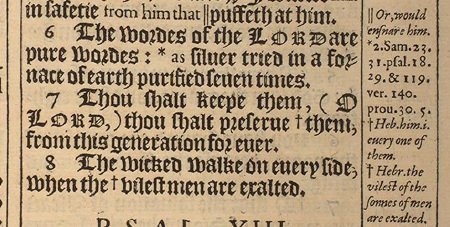
  • Bible - Psalms 12 vs 6-7 AV1611 Footnotes.jpg
    Bible - Psalms 12 vs 6-7 AV1611 Footnotes.jpg
    71.3 KB · Views: 0
When did God ever warrant that the "people of God" would have continuous access to the "real and true scriptures"? Such has never been the case, from the foundation of the church.
Continued ...

Deu_4:2 Ye shall not add unto the word which I command you, neither shall ye diminish ought from it, that ye may keep the commandments of the LORD your God which I command you.

Deu_8:3 And he humbled thee, and suffered thee to hunger, and fed thee with manna, which thou knewest not, neither did thy fathers know; that he might make thee know that man doth not live by bread only, but by every word that proceedeth out of the mouth of the LORD doth man live.

Deu 17:18 And it shall be, when he sitteth upon the throne of his kingdom, that he shall write him a copy of this law in a book out of that which is before the priests the Levites:
Deu 17:19 And it shall be with him, and he shall read therein all the days of his life: that he may learn to fear the LORD his God, to keep all the words of this law and these statutes, to do them:

Each of the kings was to have a copy made, and to read from it.

Jos_1:8 This book of the law shall not depart out of thy mouth; but thou shalt meditate therein day and night, that thou mayest observe to do according to all that is written therein: for then thou shalt make thy way prosperous, and then thou shalt have good success.

Psa 12:6 The words of the LORD are pure words: as silver tried in a furnace of earth, purified seven times.
Psa 12:7 Thou shalt keep them, O LORD, thou shalt preserve them from this generation for ever.

Context:

Psa 12:1 To the chief Musician upon Sheminith, A Psalm of David. Help, LORD; for the godly man ceaseth; for the faithful fail from among the children of men.

Psa 12:2 They speak vanity every one with his neighbour: with flattering lips and with a double heart do they speak.

Psa 12:3 The LORD shall cut off all flattering lips, and the tongue that speaketh proud things:

Psa 12:4 Who have said, With our tongue will we prevail; our lips are our own: who is lord over us?

Psa 12:5 For the oppression of the poor, for the sighing of the needy, now will I arise, saith the LORD; I will set him in safety from him that puffeth at him.

Psa 12:6 The words of the LORD are pure words: as silver tried in a furnace of earth, purified seven times.

Psa 12:7 Thou shalt keep them, O LORD, thou shalt preserve them from this generation for ever.

Psa 12:8 The wicked walk on every side, when the vilest men are exalted.

A contrast between wicked men and their words, and that of God's pure words, that are with / in God's peoples. God's words are eternal promises, and in those promises, is God's promises to deliver the godly man (men, mankind) from the ungodly. How does God deliver the godly? By placing His word in their hearts, thus preserving them (both) forever. The true epistle of God, is not paper (which will all burn in the fire to come), but are the fleshy tables of the heart, which God makes everlasting by writing His words (Law) there.

View attachment 14189

A foot (side) note, which may be taken or left as the reader pleases (that's why it is a footnote), as it reads:

God shall keep "them" (first). "them" is a pronoun, referring back to a noun. The closest antecedent is "words" (plural, vs 6), and doesn't refer back to 'him' (singular) of vs 5.

Now as to the second 'them'.

Even the verse itself is parallel:

Psa 12:7 Thou shalt keep them, O LORD, thou shalt preserve them from this generation for ever.

1a. Thou
2a. shalt
3a. keep
4a. them

1b. thou
2b. shalt
3b. preserve
4b. them

The words "preserve" and "keep" are parallel, thus equal in definition, as God's ways are equal (Eze 18:25,29). It is also given in the TSK (Treasury of Scripture Knowledge):

"them: etc. Heb. him, i.e. every one of them"

The capital "I." in the footnote (AV1611), means 'id est', or 'in other words'.

"Thou shalt keep them", (and the word "keep" is also to preserve) is a direct reference back to God's "words" in verse 6. If we accept the more literal translation of the marginal notation, for the second half, which says, "thou shalt preserve him", this too then fits with the context, since it would then be a reference to Jesus Christ (Jhn. 5:39) being preserved from the congregation of the wicked forever (for all the scriptures testify of Jesus Christ, hence the many places which has Him saying, "I am poor and needy" (Psalms 40:17, 69:2, 70:5, 86:1, 109:22 KJB)), once He is raised from death. Jesus Christ is called the "Word of God", John 1:1, etc., KJB. He pours His words into us, His children (Mat. 9:17; Luk. 5:28; Jhn. 15:7 KJB). Thus, every one in Him would be preserved (Jhn. 6:39; Jud. 1:1 KJB) along with Him. This would not negate the first half, in which God stated that He keeps His words, which includes Jesus words, Jesus Himself, and we who are in Him, being living epistles (Eze. 36:27; 2 Cor. 3:3 KJB).

Moreover

Psa 19:7 The law of the LORD is perfect, converting the soul: the testimony of the LORD is sure, making wise the simple.
Psa 19:8 The statutes of the LORD are right, rejoicing the heart: the commandment of the LORD is pure, enlightening the eyes.

Psa 33:11 The counsel of the LORD standeth for ever, the thoughts of his heart to all generations.

Psa 100:5 For the LORD is good; his mercy is everlasting; and his truth endureth to all generations.

Psa 105:8 He hath remembered his covenant for ever, the word which he commanded to a thousand generations.

Psa 119:88 Quicken me after thy lovingkindness; so shall I keep the testimony of thy mouth.
Psa 119:89 LAMED. For ever, O LORD, thy word is settled in heaven.
Psa 119:90 Thy faithfulness is unto all generations: thou hast established the earth, and it abideth.

Psa 119:150 They draw nigh that follow after mischief: they are far from thy law.
Psa 119:151 Thou art near, O LORD; and all thy commandments are truth.
Psa 119:152 Concerning thy testimonies, I have known of old that thou hast founded them for ever.

Psa 119:160 Thy word is true from the beginning: and every one of thy righteous judgments endureth for ever.

Pro 30:5 Every word of God is pure: he is a shield unto them that put their trust in him.
Pro 30:6 Add thou not unto his words, lest he reprove thee, and thou be found a liar.

Isa 30:8 Now go, write it before them in a table, and note it in a book, that it may be for the time to come for ever and ever:

Isa 40:8 The grass withereth, the flower fadeth: but the word of our God shall stand for ever.

Isa 59:21 As for me, this is my covenant with them, saith the LORD; My spirit that is upon thee, and my words which I have put in thy mouth, shall not depart out of thy mouth, nor out of the mouth of thy seed, nor out of the mouth of thy seed's seed, saith the LORD, from henceforth and for ever.

Dan_10:21 But I will shew thee that which is noted in the scripture of truth: and there is none that holdeth with me in these things, but Michael your prince.

Mat_4:4 But he answered and said, It is written, Man shall not live by bread alone, but by every word that proceedeth out of the mouth of God.

Mat 5:18 For verily I say unto you, Till heaven and earth pass, one jot or one tittle shall in no wise pass from the law, till all be fulfilled.

Mat_24:35 Heaven and earth shall pass away, but my words shall not pass away.

Mar_13:31 Heaven and earth shall pass away: but my words shall not pass away.

Luk_4:4 And Jesus answered him, saying, It is written, That man shall not live by bread alone, but by every word of God.

Luk_21:33 Heaven and earth shall pass away: but my words shall not pass away.

John 7:17 KJB - If any man will do his will, he shall know of the doctrine, whether it be of God, or whether I speak of myself.

In the days of Jesus and Paul, did they need to locate the 'originals' of Moses, David, Asaph, Jeremiah [by Baruch], Daniel, etc? Did they need to consult fragments, or did they simply quote from the presently [then] preserved words of God that they hand in/on hand?

1Pe 1:25 But the word of the Lord endureth for ever. And this is the word which by the gospel is preached unto you.

Rev 22:18 For I testify unto every man that heareth the words of the prophecy of this book, If any man shall add unto these things, God shall add unto him the plagues that are written in this book:
Rev 22:19 And if any man shall take away from the words of the book of this prophecy, God shall take away his part out of the book of life, and out of the holy city, and from the things which are written in this book.

Even as The Father preserved the body of the Word (Jesus), from seeing corruption, so the Father likewise preserves the written word from seeing corruption:

Psa_16:10 "... neither wilt thou suffer thine Holy One to see corruption."
Psa_49:9 "... not see corruption."

Act_2:27 "... neither wilt thou suffer thine Holy One to see corruption."
Act_2:31 "... neither his flesh did see corruption."

 

Martin Marprelate

Well-Known Member
Site Supporter
The best book I have come across on the subject of the Trinity is The Trinity by E.H. Bickersteth (1812-1906). It is still in print and published by Kregel books.
He supplies vast numbers of parallel texts showing that the Lord Jesus is indeed Jehovah. For instance:-

Psalm 90:2. 'From everlasting to everlasting, thou art God.'
Micah 5:2. 'Whose goings forth have been from of old - from everlasting.'

Psalm 93:2. 'Thy throne is established of old: thou art from everlasting.'
Heb. 1:8. 'Unto the Son he saith, Thy throne, O God, is for ever and ever.'

Isaiah 49:6. 'I am the first and the last; and besides me there is no God.'
Rev. 1:17-18. 'I am the first and the last: I am he that liveth and was dead.'

Jer. 23:24. 'Do I not fill heaven and earth? saith the LORD.'
Eph. 4:10. 'He that descended is the same also that ascended up far above all heavens, that He might fill all things.'

Mal. 3:6. 'I am the LORD, I change not.'
Heb. 13:8. 'Jesus Christ, the same yesterday, today and for ever.'

Deut. 32:4. 'A God of truth and without iniquity.'
John 14:6. 'I am ... the truth.' Heb. 4:15. '... Without sin.'

Prov. 16:4. 'The LORD hath made all things for himself.'
Col. 1:16. 'All things were created by him and for him.'

Psalm 145:13. 'Thy kingdom is an everlasting kingdom, and thy dominion endureth throughout all generations.'
Dan. 7:14. 'His dominion is an everlasting dominion .... and his kingdom that which shall not be destroyed.'

And so forth for page after page. Loads more where these came from.
 

cjab

Active Member
I have always felt that the simplest way to illustrate the two natures of Christ is found in the account of the Stilling of the Storm (Mark 4:35-41 etc.).
When the Lord Jesus comes onto the boat, He goes to sleep on a cushion. Why does He do that? Because He is tired. He is a Man; Man as though He were not God. Elsewhere, He is hungry, thirsty and sad enough to weep. He is true Man.
But when the storm arises, and the disciples come to Him in great fear and wake Him, He stills the storm with a word. He does not pray to the Father to still it for Him; He Himself stills the storm. Who else can do that save Almighty God? He is God; God as though He were not Man. He is true God.
I regard your terminology as alien to the bible and due to your comprehension of the bible being defective.

Thus, you surrender "Lord" and call Jesus "God." Why? Christ is "Lord" as he taught himself, and the Father is "God." Both have authority over creation. That Christ exercises direct authority over creation shouldn't give rise to any confusion with his Father, because he demanded none and was always so careful to distinguish himself from his Father. "Almighty God = Lord God = Lord God Almighty" is plainly a title of the Father to the exclusion of the Son: Rev 21:22 "And I saw no temple therein: for the Lord God Almighty and the Lamb are the temple of it." Also Luke 1:32 "He will be great and will be called the Son of the Most High. The Lord God will give him the throne of his father David."

The NT nomenclature plainly reserves the <theos> title to the Father (= "God") whilst conceding the Son is the image of the Father/God.

What does the Chalcedonian Creed say? 'We all, with one voice, confess our Lord Jesus Christ, one and the same Son, at once complete in deity and complete in humanity, truly God and truly Man.....One and the same Christ, Lord, only-begotten, to be acknowledged in two natures, without confusion, without change, without division, without separation; the distinction of the natures being in no way abolished because of the union, but rather the characteristic property of each nature being preserved, and coming together to form one Person and one hypostasis. He is not split or divided into two Persons, but He is one and the same Son and only-begotten, God the Logos, the Lord Jesus Christ, as formerly the prophets and later Jesus Christ Himself have taught us about Him, and as it has been handed down to us by the Creed of the Fathers.'
I reject the Chalcedonian creed as an addition to the bible: one of its major failings is to confound form and hypostasis. It makes out that hypostasis takes account of form, which I reject. I see the hypostasis of Christ as unchangeable, whether in heaven or on earth. I also discount the idea of two distinct natures, which suggests Christ never became fully flesh. A separate point is that English translations of old Greek texts are never to be trusted: they always translate <theos> as "God" but this doesn't accord with the Greek language where <theos> is not a proper noun and can be used in predicate constructions to denote nature separately from title. And in respect of Jesus the man, the "nature" designator is <monogenes theos> (John 1:18) rather than <theos> which applies to his heavenly persona; and which most High Trinitarians ignore. English speakers also use "God" as a nature designator, whereas it cannot be used in this sense, as it denotes a proper noun: the supreme being. This too engenders no little absurdity, as it gives rise to multiple "supreme beings" e.g. Heb 1:8,9, as if paganism.
 

cjab

Active Member
The best book I have come across on the subject of the Trinity is The Trinity by E.H. Bickersteth (1812-1906). It is still in print and published by Kregel books.
He supplies vast numbers of parallel texts showing that the Lord Jesus is indeed Jehovah.
That sounds like Modalistic Monarchianism, or else pagan polytheism. I have always regarded the High Trinity as a permanent equilibrium of these two concepts. The biblical conception of the divine order if strictly hierarchical: 1 Cor 11:3. "God over Christ over Man over Woman." It is the foundation of everything. Reject it and you are lost, and unfortunately the Latin Trinity of the Athanasian Creed type does reject 1 Cor 11:3.
 

cjab

Active Member
You are even confused as to what the "church" is.

Act_7:38 This is he, that was in the church in the wilderness with the angel which spake to him in the mount Sina, and with our fathers: who received the lively oracles to give unto us:
Act 7:38 ουτος εστιν ο γενομενος εν τη εκκλησια εν τη ερημω μετα του αγγελου του λαλουντος αυτω εν τω ορει σινα και των πατερων ημων ος εδεξατο λογια ζωντα δουναι ημιν

The "church" is far older than the NT period.
Never said it wasn't.

The "peoples of God" have always had the words of God, even from the time of Adam (though not yet then in written form, but memory / verbal, even as seen in Job, and even the heavenly angels before that). There are many texts which show that God's words, inspired, are preserved, alive with the "peoples of God".

Heb_4:12 For the word of God is quick, and powerful, and sharper than any twoedged sword, piercing even to the dividing asunder of soul and spirit, and of the joints and marrow, and is a discerner of the thoughts and intents of the heart.
Heb 4:12 ζων γαρ ο λογος του θεου και ενεργης και τομωτερος υπερ πασαν μαχαιραν διστομον και διικνουμενος αχρι μερισμου ψυχης τε και πνευματος αρμων τε και μυελων και κριτικος ενθυμησεων και εννοιων καρδιας

...
Fact is most of the bible didn't even exist at the time of the Patriarchs, but they still managed to obey God.
 

cjab

Active Member
Even as The Father preserved the body of the Word (Jesus), from seeing corruption, so the Father likewise preserves the written word from seeing corruption:

Psa_16:10 "... neither wilt thou suffer thine Holy One to see corruption."
Psa_49:9 "... not see corruption."

Act_2:27 "... neither wilt thou suffer thine Holy One to see corruption."
Act_2:31 "... neither his flesh did see corruption."
It is obvious that the text of the NT was corrupted and changed in many places in the first few centuries after Christ. The Byzantine Text Type is extensively stylised to inculcate a later High Trinitarian theology that didn't exist in the apostolic church, although it certainly wasn't unitarian, but as unitarians now do assert. 1 Tim 3:16 is a good example.
 

SovereignGrace

Well-Known Member
Site Supporter
Nothing you have said infers that Jn 1:1c, in the context of Jn 1:1b, means anything more in Greek than the oft-used Pauline phrase "Christ is the image of God."
Why sure it does. It says He was with God and was God. It then says the Word became flesh, vs 14. Its there as plain as the nose on your face.
 
Why sure it does. It says He was with God and was God. It then says the Word became flesh, vs 14. Its there as plain as the nose on your face.
His 'logic' is, essentially, that if in one place the text says that Christ is a priest:

Heb_7:21 (For those priests were made without an oath; but this with an oath by him that said unto him, The Lord sware and will not repent, Thou art a priest for ever after the order of Melchisedec:)

That there cannot be another place which says that Jesus is also "high priest", which is more than a priest.

Heb_7:26 For such an high priest became us, who is holy, harmless, undefiled, separate from sinners, and made higher than the heavens;

Thus, in one place, Christ is "the image of God" (His Father), another place cannot additionally say, "the Word was God", as his 'logic' goes.
 
You have shown nothing. No serious academic would take the least notice of anything you said.
You seem to only include 'academics' which agree with you (in part), while at the same time, those same 'academics' which you 'cite' (in part), generally agree (certain exceptions of course) that the Son of the Father is eternal Deity (God). Why do you accept them in one place, when it suits you, and not in another when it doesn't? Are you "wiser" than they at that particular point? if so, demonstrate how so.

For instance, Bruce Metger (you brought up; a Presbyterian - Bruce M. Metzger - Wikipedia ), is under the 'traditional' "trinitarian" view. For instance, just a quick search, reveals:

"One of the most famous quotations by renowned New Testament scholar Bruce Metzger regarding the eternal Deity of Jesus Christ is his sharp critique of the Arian and Unitarian translations of John 1:1. He wrote: [1]

"It must be stated quite frankly that, if the Jehovah's Witnesses take this translation seriously, they are polytheists... As a matter of solid fact, however, such a rendering is a frightful mistranslation." [1]

Metzger, writing in Theology Today (1953), defended the orthodox view of Jesus's pre-existent, eternal deity. Furthermore, in discussions regarding John 10:30 ("I and the Father are one"), the argument is often framed—consistent with the theological position held by scholars like Metzger—that Jesus must be understood as either truly God, a liar, or insane, leaving no other options for his claims to divinity.

[1] “The Jehovah’s Witnesses and Jesus Christ,” Theology Today (April 1953), p. 75. - John 1:1 and the New World Translation | Christian Research Institute

A person can also read His book, "The Jehovah's Witnesses and Jesus Christ by Metzger, Bruce M. (Bruce Manning), 1914-2007" - The Jehovah's Witnesses and Jesus Christ : Metzger, Bruce M. (Bruce Manning), 1914-2007 : Free Download, Borrow, and Streaming : Internet Archive
 
Top