• Welcome to Baptist Board, a friendly forum to discuss the Baptist Faith in a friendly surrounding.

    Your voice is missing! You will need to register to get access to all the features that our community has to offer.

    We hope to see you as a part of our community soon and God Bless!

Atonement (Not PSA)

JonC

Moderator
Moderator
I want to speak respectfully here, because my concern is not with you as a person, but with the view itself. I cannot accept the idea that the cross was not a legal, substitutionary act, because Scripture uses that language directly. The Bible says, “The wages of sin is death” (Romans 6:23), and it also says that Christ “was wounded for our transgressions” and that “the chastisement of our peace was upon him” (Isaiah 53:5). Paul writes that Christ “redeemed us from the curse of the law, being made a curse for us” (Galatians 3:13). These are not later theological additions. They are the words of God.

For that reason, I believe the substitutionary and penalty‑bearing nature of the cross is part of the plain teaching of Scripture. My disagreement is not with your sincerity or your desire to honor the text. It is simply that when I read these passages, I see substitution everywhere, and I cannot set that aside without setting aside the language Scripture itself uses. Yours in Him, Tony
Thank you for being respectful. I hope I come across the same.

I agree with you. The cross was substitutionary rather than a legal act. We can know this as a fact several ways. Jesus is the "last Adam" of whom Paul spoke. In Him God was reconciling man to Himself. I would even say this is inherent in the Word becoming flesh.

I also believe that Christ bore our sins so we would bear His righteousness, that God laid our iniquity on Him so that God would clothe us in His righteousness. It pleased the Lord to crush Him, to put Him to grief, and it is by His stripes we are healed. He did become a curse for us to redeem us from the curse. He was made sin for us.


I am not saying that the Atonement is less than substitutionary, far from it. I am saying that Christ did not die as a penal substitute.

Penal Substitution is both legal and substitution. It is a type of substitution that satisfies a judicial demand. Otherwise you have a form of Anselm's view (Christ stepping in for us to accomplish what Adam could not by merit).

BUT penal substitution views Jesus as suffering divine punishment instead of us. The penal part makes the theory a legal act via substitution.


If penal substitution were in fact the "plain teaching of Scripture" then you would have provided a passage actually teaching penal substitution. But you didn't. You provided passages that Christians believed centuries before penal substitution was articulated.


Now - I do believe that when you read the Bible you see penal substitution all over the place. I believe that for two reasons. First, you strike me as an honest man. Second, I also saw penal substitution from Genesis to Revelation. Once somebody tells you the ink blot is a bat you can never see it for what it really is.

But that is you, and was me. Who cares what people "see" as being taught by the Bible? These understandings are a dime a dozen. What matters is not our understanding of what we think the Bible teaches but the words that proceed from God.
 

JonC

Moderator
Moderator
@Anthony Pritchard

I know people define terms differently. On this board we have several who believe they hold Doctrines of Grace while rejecting a major point if the doctrine. So I like to ask a few questions so that I better understand your perspective.


1. Do you believe that God forgives sins or that God must punish sins in order to be just?

Typically PSA theorists believe the latter. John Calvin held that judicial philosophy (secularly and theologically) and in developing PSA Calvin explained that justice requires all crimes be punished as it is the duty of the judge to avenge the law.

God, under this view, satisfies the requirements of justice by punishing the Just in order to clear the guilty. But this is not forgiveness. Forgiveness is not dependent on the means or the one being forgiven.

I ask this because I do not believe that judicial philosophy is just, much less divine justice.

2. Do you believe that God views punishing the Just and clearing the guilty both to be abominations? If so, do you believe God punished Jesus instead of us?

I ask this one because I do not believe God punishes the Just. I also do not believe God will clear the guilty.
 
@Anthony Pritchard

I know people define terms differently. On this board we have several who believe they hold Doctrines of Grace while rejecting a major point if the doctrine. So I like to ask a few questions so that I better understand your perspective.


1. Do you believe that God forgives sins or that God must punish sins in order to be just?

Typically PSA theorists believe the latter. John Calvin held that judicial philosophy (secularly and theologically) and in developing PSA Calvin explained that justice requires all crimes be punished as it is the duty of the judge to avenge the law.

God, under this view, satisfies the requirements of justice by punishing the Just in order to clear the guilty. But this is not forgiveness. Forgiveness is not dependent on the means or the one being forgiven.

I ask this because I do not believe that judicial philosophy is just, much less divine justice.

2. Do you believe that God views punishing the Just and clearing the guilty both to be abominations? If so, do you believe God punished Jesus instead of us?

I ask this one because I do not believe God punishes the Just. I also do not believe God will clear the guilty.
Brother, thank you for your thoughtful and respectful reply. I appreciate the tone, and I want to answer in the same spirit. I do not want to argue philosophy or systems, only to stay with the words God has given us.

For me, the question is not whether the atonement is substitutionary. We both agree it is. The question is whether Scripture itself describes that substitution in penal terms. When I read the passages, I see that it does.

“The wages of sin is death” (Romans 6:23). “Christ hath redeemed us from the curse of the law, being made a curse for us” (Galatians 3:13). “He was wounded for our transgressions… the chastisement of our peace was upon him” (Isaiah 53:5). “The Lord hath laid on him the iniquity of us all” (Isaiah 53:6). “He made him to be sin for us” (2 Corinthians 5:21).

These are not philosophical categories. They are the Spirit’s own words. Wages, curse, chastisement, iniquity laid on another, sin borne by another. These are penal terms. They describe guilt, consequence, and judgment transferred to a substitute.

To your first question, yes, I believe God forgives sins. But Scripture also says that forgiveness is grounded in the shedding of blood. “Without shedding of blood is no remission” (Hebrews 9:22). Forgiveness is free to us, but it was not free in itself. It was purchased.

To your second question, I do not believe God punishes the just in the sense of condemning the innocent. But I do believe what Scripture says, that Christ “the Just for the unjust” suffered once for sins (1 Peter 3:18). He was not punished as a sinner. He bore the penalty of sin as the spotless Lamb of God. That is why He could redeem us.

So my disagreement is not with your sincerity or your desire to honor the text. It is simply that when I read these passages, I cannot separate substitution from the penal language God Himself uses. I do not want to add anything to Scripture, but I also do not want to remove anything from it.

I appreciate the conversation, Brother, and I am grateful for the respectful tone.
 

old regular

Active Member
Signs Of The Times 1899:
Atone means to make reparation, satisfaction and reconciliation. When this is done, the injury is atoned for. Atonement applies to sin or wrong doing. Sin is violation of law, either divine or human. To every transgression of law there is a penalty. The laws of God are so strong and perfect that every sin must receive its just penalty. God is holy and he will never pardon the least sin, unless it is atoned for. To do this, the broken law must he fulfilled. Perfect obedience only will fulfill and satisfy the law. No sinner can do this, because he is already imperfect and disabled or weak. Sin entails guilt, condemnation and death. The whole world is guilty before God, because all have sinned. “The wages of sin is death,” and every sinner must die. God is just and holy, therefore, in the condemnation of all men under his holy law. Right here is where the truth of salvation by free grace alone comes in, and every mouth is stopped, because there is none good, no, not one. None have any claim upon God for justification, or any blessing. “Therefore by the deeds of the law there shall no flesh be justified in his sight.” All men in the flesh are forever condemned by the law, and are under its curse. Mercy and grace only can save any sinner. Yet all men in the flesh depend upon their works to obtain salvation, and they claim the blessings of God as rewards for religious service. They make salvation conditional in part upon their supposed obedience to the holy commandments of God. Thus, thy must either hold that their obedience is perfect, or that the divine commandments are imperfect and will accept of faulty obedience. This was the fatal blindness of the Jewish Pharisees, who trusted in themselves and their self- righteousness. They therefore did not believe in Christ as the Savior of sinners, nor trust in his atoning blood to cleanse them from all sin. Nay, but they depended upon their boasted ability and good works to make atonement or satisfaction to the law of God, which is holy. Just so does every doctrine and principle of conditional salvation on man’s part virtually deny both the complete fullness and sufficiency of Christ’s atonement and the need of it; for every feature and sort of conditional salvation necessarily claims to save us from some sin and its punishment or wages. This is nothing else but making atonement in part for ourselves, by our works of conditional salvation. It is evident, therefore, that the doctrine of conditional salvation, in any part, is a denial of the perfection and fullness of Christ’s atonement for all the sins of his people. For a full and complete atonement for all our sins, is full redemption, free justification and perfect salvation. Conditional salvation from any sin, either of commission or omission, contradicts this full and perfect salvation through the atonement of our Lord and Savior Jesus Christ, and charges imperfection and failure in part to his perfect work of obedience unto righteousness and full justification and salvation. Conditional salvation denies that all salvation and its joys and blessings come to us through Christ’s atoning suffering unto death for our sins, but claims that salvation in part comes to us because of our own obedience; that is, the atonement for our sins of disobedience is in part conditional, and depends upon our good works of obedience. There is no escape from this fatal consequence of conditional salvation, for all salvation is from sin and death, and that which brings salvation is an atonement for sin; if this is our works, then it is not the blood of Christ that obtains our salvation and God’s blessing. Unitarians deny the divinity, vicarious sufferings and atonement of our only Lord Jesus Christ; therefore they depend upon their own works of supposed obedience to the commandments of God to atone for their sins and obtain salvation for themselves; that is, they hold to personal atonement by works of obedience, and to conditional salvation either present or future; for it all depends upon works, and is not by grace.
With thanks to God for his unspeakable gift, we turn away from this bloodless atonement and faithless salvation, to the “fountain filled with blood, drawn from Immanuel’s veins, and sinners plunged beneath that flood lose all their guilty stains,” and in joyful faith and praise we say,
“Unto him that loved us, and washed us from our sins in his own blood, and hath made us kings and priests unto God and his Father; to him be glory and dominion forever and ever. Amen.”
Let us notice, 1st. The necessity of the atonement. We read, “Without shedding of blood is no remission.” “For all have sinned, and come short of the glory of God.” “There is none righteous, no, not one.” “And so death passed upon all men, for that all have sinned.” “For the wages of sin is death.” The Savior of shiners, therefore, must give his life-blood and die for their sins, as the atoning sacrifice and price of their redemption. Christ thus gave himself for all his people, and made this perfect offering and sacrifice of himself. “By his own blood he entered in once into the holy place, having obtained eternal redemption for us.”
2nd. The completeness of Christ’s atonement. Atonement must cover all sin, pay all the debt, redeem from all iniquity, remove all guilt and every curse, and justify from all things, in order to fulfill the law and satisfy justice. Should the least stain of sin remain upon the body of Christ, the church, then both he and his people for whom he died must have remained forever under the curse of the law, and the dominion of sin and death. Paul shows this in 1 Cor. xv. But blessed be God, the obedience and death of his holy Son possessed this perfection and infinite merit and saving power. So, we read, “While we were yet sinners, Christ died for us. Much more then, being now justified by his blood, we shall be saved from wrath through him.”
3rd. Since the atonement of Christ removes all guilt and cleanses from all sin, it freely justifies us from all things, and none can condemn or lay anything to the charge of God’s elect. “There is therefore now no condemnation to them which are in Christ Jesus” “For by one offering he hath perfected forever them that are sanctified.”
4th. Paul testifies that God raised Christ from the dead for our justification, and that whom God justifies he also glorifies. “Being justified freely by his grace through the redemption that is in Christ Jesus.” This full and free justification not only makes us forever free from all sin and guilt and condemnation, but it also brings us into righteousness and salvation and eternal life, as heirs of God and joint-heirs with Christ. “For if, when we were enemies, we were reconciled to God by the death of his Son, much more, being reconciled, we shall be saved by his life.”
5th. The atonement of Christ, then, makes an end of sin, destroys death, and brings in life and immortality for all who are his. This is the holy and blessed estate of all for whoso sins Christ died. Their sins are all blotted out forever for Jesus’ sake, and they have free and full and everlasting forgiveness from God their Father. Yea, they are born of God, have passed from death unto life, and shall live for evermore, because Christ lives in them. His fullness of grace and glory is theirs in him, and in him is their full salvation and all spiritual blessings, both for time and eternity. “If Christ is mine, then present things and things to come are mine.” When Christ, who is our life, shall appear, then shall we also appear with him in glory.
D. Bartley
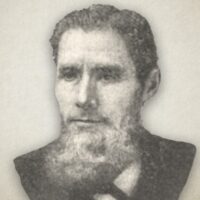


David Bartley

David Bartley (1826-?) was an American Primitive Baptist preacher. He served the pastorate of several churches and became a popular itinerate preacher traveling to many parts of the United States. He was a frequent contributor to Gilbert Beebe’s the Signs of the Times and was the author of several books.


\​


atpollard

Well-Known Member
"But go and learn what this means: 'I desire mercy and not sacrifice.' For I did not come to call the righteous, but sinners, to repentance."
- Jesus Christ
 
Top
