Would say this is very interesting survey on this topic
Home - The King James Bible Study Project
 kjbstudyproject.com

Welcome to Baptist Board, a friendly forum to discuss the Baptist Faith in a friendly surrounding.
Your voice is missing! You will need to register to get access to all the features that our community has to offer.
We hope to see you as a part of our community soon and God Bless!
Would say this is very interesting survey on this topic
kjbstudyproject.com
Did the Church of England makers of the KJV arbitrarily and intentionally change the meaning of certain Bible texts in the pre-1611 English Bibles to make them more favorable to Church of England episcopal church government? Did the makers of the KJV remove vital words or phrases at Acts 14:23 that relate to the doctrine of church government?And you should be thrilled to hear of those that arbitrarily change the meaning of certain Bible texts, removes vital words and phrases from certain passages, and diminish the Authority of the Bible.
The serious problem and alarming inadequacy with KJV-only articles and books is their dependance upon fallacies and their use of double standards as they fail to apply their exact same standards or measures that they use to accuse post-1611 English Bibles to the KJV itself.Then you should be Praising God Almighty for innumerable articles and books on any number of 'versions of the Bible' which contain glaring and alarming inadequacies and that weaken, change, or delete certain Doctrines of the Word of God

"H" is a strange initial letter. I can remember when British people used to say, "an hotel," whereas now, almost everybody says "a hotel." I just did a search, and found that the KJV used "a holy" 57 times, and "an holy" 40 times.Sorry to be pedantic, but you meant "starting with a vowel," I think. The unique thing about the KJV is that it also puts an "an" before a word beginning with "h" as in 'a just man and an holy.' What an horrible thing to do!Actually, it's just what people used to do in the 17th Century.

Definitely the work of a committee.The KJV has "an house" 72 times, and "a house" 6 times.


It's still done occasionally in the American tongue,Sorry to be pedantic, but you meant "starting with a vowel," I think. The unique thing about the KJV is that it also puts an "an" before a word beginning with "h" as in 'a just man and an holy.' What an horrible thing to do!

You want to check them against complete manuscripts, like the King James Version, and see what we already knew God said, before someone sold the idea that the collections of manuscripts they and so many others used through the centuries were corrupted and needed to be dismissed and ignored and replaced exclusively with some of the most tampered with and suspect documents in religion.I'd check any Reader's Digest wannabe abridgements that have removed generous portions of THE WORD OF GOD
No, the Holy Spirit did not Lead gentlemen to conduct their translations under the lie that the collections of manuscripts the King James translators and so many others used through the centuries were corrupted and needed to be dismissed and ignored and mostly replaced exclusively AND MODERNIZED with the Roman Catholic documents resurfaced from the dark underground after hundreds of years of non-use (if they're that old).as if we're supposed to believe the Holy Spirit Led them to play god.
"The Spirit Who Spoke in Ancient Days to and through the Prophets and Apostles still Speaks to us through the Written Record of that Revelation, saying, 'Hear, and your soul shall Live.' In the Bible, therefore, we find not only what the Spirit said to the churches of the first century, but what He is still saying to those of the twentieth (& twenty-first). But what He says to us is in Perfect Harmony with what He said to them.WHEN JESUS SAID THEY "ARE SPIRIT AND LIFE"
I know you are not defending limiting the Word of God, and when I said that they are 'Reader's Digest wannabe abridgements that have removed generous portions of THE WORD OF GOD', that I am not somehow suggesting that there needs to be dozens of more books and chapters added to any complete copies of the Bible."Bring back the 88 book Ethiopian Orthodox Tewahedo Bible!" ... is that what you meant?
The King James Version is not a manuscript. The KJV is one English Bible translation in the same sense (univocally) as the pre-1611 English Bibles are English Bible translations. Do you try to sell people on the non-true claims for the KJV?You want to check them against complete manuscripts, like the King James Version, and see what we already knew God said,
Oh yeah, this is where I told everyone in my post somewhere to remind me of how some people are utterly dependent on labeling anyone that sees even '1 Problem' with any one of the 'modern translations' as KJV-Only.Do you try an inexcusable, irresponsible hack job as you throw out misleading and incorrect accusations against believers who disagree with human, non-scriptural KJV-only reasoning/teaching?
This is dishonest to make this general declaration of anybody that 'accepts or makes some type of exclusive claims for only one English Bible translation—the KJV', because you actually really do always demand that anyone who sees the '1000 Problems' in every one of the 'modern translations' is a Quack, like your most beloved person ever in the World, Peter Ruckman.The accurate term KJV-only is used by Bible believers to define and describe any view that accepts or makes some type of exclusive claims for only one English Bible translation—the KJV.
At least you proved that all that is not really any 'Problem', if anybody was talking about making "a" to "an" and "an" to "a" in that article.Later KJV editors changed “a hundred” (Exod. 38:9, Jud. 20:10, 1 Kings 7:2) to “an hundred” while they kept “a hundred” once (Isa. 37:36). They revised “a house” (1 Chron. 17:5) to “an house” while “a house” was left at other verses (Exod. 12:30, Lev. 14:34, etc.). They changed “a hill” (Isa. 30:17) to “an hill” while “a hill” was kept once (Josh. 24:33). Later editors also left the inconsistencies of “an hairy” (Gen. 25:25) and “a hairy” (Gen. 27:11), “a harp” (1 Sam. 10:5) and “an harp” (1 Sam. 16:16, 23), “a heap” (Isa. 17:11) and “an heap” (Isa. 25:2), “an hammer” (Jud. 4:21) and “a hammer” (Jer. 23:29), “an highway” (Isa. 11:16) and “a highway” (Isa. 19:23), “an holy” (Exod. 19:6) and “a holy” (Isa. 30:29), and “an house“ (Mark 3:19) and “a house“ (Mark 3:25).
Your own posts demonstrate that you believe some non-scriptural KJV-only reasoning/teaching. It is your own statements that would identify your view as KJV-only.There it is. I don't believe any KJV-only reasoning/teaching. However, you are 'utterly dependent on labeling anyone that sees even '1 Problem' with any one of the 'modern translations' as KJV-Only'.
That's all the criteria it takes for me to call you a KJV-Only Ruckmanite.
Kjvo can not ever give which of the Kjv editions are the perfect one to g=follow, nor which TR Greek text is that perfect text to useOh yeah, this is where I told everyone in my post somewhere to remind me of how some people are utterly dependent on labeling anyone that sees even '1 Problem' with any one of the 'modern translations' as KJV-Only.
There it is. I don't believe any KJV-only reasoning/teaching. However, you are 'utterly dependent on labeling anyone that sees even '1 Problem' with any one of the 'modern translations' as KJV-Only'.
The 'modern translations' have too many 'Problems' to count, seriously. So, why fool with them?
You still have to check a reliable source on every verse, similar to the KJV, to see if they are 'accurate',
so that you can know all of what God said.
This is dishonest to make this general declaration of anybody that 'accepts or makes some type of exclusive claims for only one English Bible translation—the KJV', because you actually really do always demand that anyone who sees the '1000 Problems' in every one of the 'modern translations' is a Quack, like your most beloved person ever in the World, Peter Ruckman.
I know you love him because you typed the letters 'KJV'.
That's all the criteria it takes for me to call you a KJV-Only Ruckmanite. So, you're a Quack.
That's fair. How do you like that?
The only things you know are,
#1) you don't have two cents worth of defense for the 'modern translations' '1000 Problems', other than to devour the KJV
and #2) pretend everyone's that uses the KJV is a KJV-Only nutcase and, therefore, an easy target for you to cowardly attack.
In between there is the most Magnificent Supernaturally Superintended work of literature ever written.
THERE IS NOTHING WRONG, AND NOTHING YOU CONTROL AND TRY TO MAKE WRONG, ABOUT SOMEONE WHO EXCLUSIVELY ENJOYS THE KJV, AND WHO DON'T CARE TO TOUCH THE 'MODERN TRANSLATIONS' FOR ANY REASON, AND THAT DOESN'T MAKE ANYONE A RUCKMANITE BY DEFAULT.
YOU LIE JUST LIKE THE TRANSLATORS AND PUBLISHERS OF THE 'NOT REVISED STANDARD' TO THE 'NOT A NEW KING JAMES'.
IT MEANS THEY WORSHIP GOD WITH A BIBLE THAT WAS AROUND BEFORE THE 'MODERN TRANSLATIONS' AND WHEN THERE WAS NOBODY TO CRY ABOUT THEM STUDYING THE BIBLE WITHOUT PURCHASING A 'MODERN ONE' AT ALL.
DO YOU WORK FOR SOME BRANCH OR OTHER OF THE 'MODERN TRANSLATION' SALESFORCE AND RECEIVE CASH FOR BASHING THE KJV? YOU NEVER WILL ANSWER THAT QUESTION.
How else could someone continue to be such a 'Ruckmannite-type-non-thinking' lamebrain?
You have no Earthly idea what versions, or in what languages, I use.
You are always lying when you smear me by calling me KJV-only, by which you mean 'mentally deranged' about how we got our Bibles and you need to cease and desist from associating me with all that stupid dummy stuff you always list about Ruckmanites.
At least you proved that all that is not really any 'Problem', if anybody was talking about making "a" to "an" and "an" to "a" in that article.

Well said!"...to g=follow..."
So when it can be clearly demonstarted that the kjv and the Greek text was not always in full agreement, then the Kjv is right and the originals language text was wrong?Some KJV defenders strongly object to being identified accurately as KJV-only even though they clearly have made exclusive claims for only one English Bible translation--the KJV.
For one example, D. A. Waite (1927-2024) has clearly made some exclusive "only" claims for the KJV that would provide valid, sound, convincing evidence for considering his position to be a form of “KJV-only” view. D. A. Waite claimed: "There are no good translations except the King James Bible" (Central Seminary Refuted, p. 129). Waite asserted: "The King James Bible is the only accurate English translation in existence today" (p. 47). Waite declared: "If you use any other version than the King James Bible you are tampering with the Words of God" (p. 136). Waite claimed: "The King James Bible is always superior to all others in the English language" (p. 80). Waite declared: “I believe that the King James Bible is the only one that English speaking Christians ought to use” (p. 5). Waite wrote: "The only valid Bible is the King James Bible" (p. 131). Waite asserted: “I believe that one translation should be set up as a standard. The translation of the King James Bible is a standard” (p. 23). Waite claimed: “Loyalty to Christ and His Words are measured by what version you use” (p. 133). Waite declared: “It is my firm conviction that anyone who does not use the King James Bible to preach from, teach from, or study from has something defective in that individual’s knowledge of the Scriptures” (p. 144).
In another book, D. A. Waite stated: “I am one of the Christians who contend that only the King James Bible gives us the Words of God in English” (Fundamental Deception, p. 33). Waite maintained that the KJV "is the only acceptable translation from the preserved Hebrew and Greek texts" and "is the only true Bible in the English language" (Fuzzy Facts, pp. 8-9). Waite asserted that the KJV “is the only accurate translation” or “the only accurate, faithful, and true translation” (Critical Answer to James Price’s, pp. 5, 41, 131). Waite wrote: “The King James Bible, because of its accurate translation of those Words [Hebrew, Aramaic, and Greek], can honestly and truly be called God’s Words kept intact in English” (p. 109). Waite asserted: "I do not say that the King James Bible is 'fallible' or 'errant.' I don't believe that there are any translation errors in the King James Bible” (Fuzzy Facts, p. 44). Waite declared: “I have said many times before, and I believe, that there are no ‘translational errors’ In the King James Bible” (Critical Answer to Michael Sproul’s, p. 42). Waite wrote: “I have never said I believe in ‘an inerrant KJV.’ That is pure Ruckmanism” (p. 65). When Waite himself directly and clearly contended that the KJV “is ’God’s Word kept intact’” and that “intact” means “not touched” and “nothing harms or defiles it,” he would seem to be in effect or in practice trying to claim or at least imply perfection for the translating in the KJV (Defending the KJB, p. 1). Waite asserted: “The KING JAMES BIBLE is the Word of God in English, and the other versions are not” (p. 52).
Well said!...clerly demonstarted...
not excluding the consent of the people, but given them power, if they have any reason to dissent, to declare the causes of their lawfull refusal, so that none be admitted to Ecclesiastical Functions without the privity, open notice given, and the acceptance of the whole Church:
So Paul and Barnabas are said to have appointed Elders in the Churches, not according to their own private pleasures, but by advisement of the people, first by wholesome counsel, and yet the people declaring their voices or consent by holding up of their hands. And then they had ordained them Elders by voices (or holding up of hands) in the Church, said Luke, Acts 14:23.
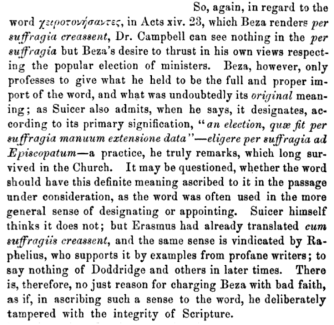
Did the Church of England makers of the KJV arbitrarily and intentionally change the meaning of certain Bible texts in the pre-1611 English Bibles to make them more favorable to Church of England episcopal church government? Did the makers of the KJV remove vital words or phrases at Acts 14:23 that relate to the doctrine of church government?
Nothing about an elementary understanding of the word involved gives any reason for concern regarding the procedures in New Testament church government by democratic vote of the congregation.This article connected the change with the Church of England’s doctrine of apostolic succession.
...in Acts 14:23 where either the KJV translators, Archbishop Richard Bancroft, Bishop Thomas Bilson, or another prelate omitted the words "by election"
|
Tyndale's New Testament, Coverdale's Bible, Matthew's Bible, Great Bible, Taverner's Bible, Jugge’s New Testament, Whittingham’s New Testament, Geneva Bible, and Bishops' Bible ("ordained them elders by election").