• Welcome to Baptist Board, a friendly forum to discuss the Baptist Faith in a friendly surrounding.

    Your voice is missing! You will need to register to get access to all the features that our community has to offer.

    We hope to see you as a part of our community soon and God Bless!

Atonement (what is written)

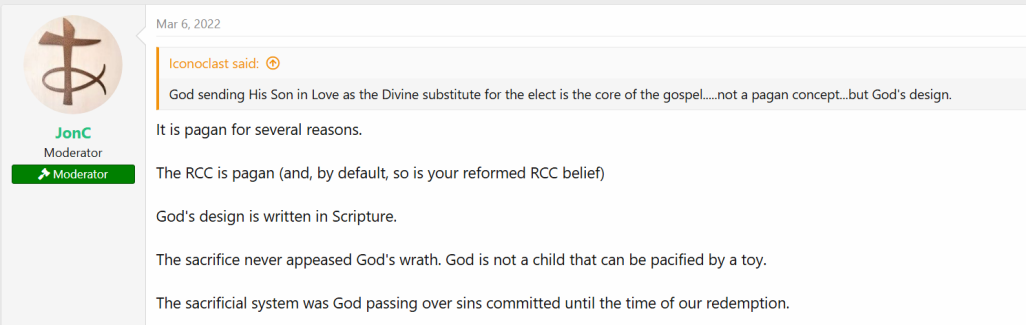
JonC

Moderator
Moderator
It makes perfect sense. Wouldn't you say that Christians and Jews just have a different understanding of the law and the prophets?

What of the Eucharist ?

Whoso eateth my flesh, and drinketh my blood, hath eternal life; and I will raise him up at the last day. For my flesh is meat indeed, and my blood is drink indeed. He that eateth my flesh, and drinketh my blood, dwelleth in me, and I in him. - Jhn 6: 54-56 KJV

Just a different understanding? Look at the actual words.
It depends on the Jew, I suppose. If you mean Judiasm, I guess it depends on the Christian. I do not know everybody's view of the prophets and the law.

The Eucharist is a better example. Basing an entire doctrine on one interpretation of a single verse is problematic (Jesus had already explained the elements, and so had the phrophets).

The Catholic Church essentially ignored many passages speaking of the body and blood, ignored the first part of that passage (rememberance), and carried over Roman paganism of the host into their theology.

Would I tell a Catholic who is a Christian that they must not take those words literally, they must include the first part of the verse? I may suggest it, but in the end that error would be an erroneous interoretation of the actual text (which is different from the error PSA theorists make mishandling Scripture).


I do agree that PSA theorists ignore quite a bit of Scripture in developing their theory, and they do redefine some words to suit their needs. So did Anselm when he viewed the Atonement through his philosophy and determined it points to the restoration of honor. But ultimately what we have in common is the same Scriptures.

That is what I mean by the passages we do use are the same. But there are passages that the theorists have to ignore, just as there are passages Catholics have to ignore.
 

Aaron

Member
Site Supporter
It depends on the Jew, I suppose. If you mean Judiasm, I guess it depends on the Christian. I do not know everybody's view of the prophets and the law.
Baloney. You know exactly what I mean. The Jews believed they were being true to the text, too, and they missed their Messiah.

You say you’re being true to the text, but you're not. You're merely leveraging a hyper-pedantry to keep your thumb on the scales.

In the sin offering the sin is judged. In the Trespass offering, the debt of sin is paid.

The tree of Deuteronomy, the Cross, is a judicial penalty. A just punishment for sin.

Jesus was punished for our sins. That's an offense to some, unfortunately for them.
 

JonC

Moderator
Moderator
Baloney. You know exactly what I mean. The Jews believed they were being true to the text, too, and they missed their Messiah.

You say you’re being true to the text, but you're not. You're merely leveraging a hyper-pedantry to keep your thumb on the scales.

In the sin offering the sin is judged. In the Trespass offering, the debt of sin is paid.

The tree of Deuteronomy, the Cross, is a judicial penalty. A just punishment for sin.

Jesus was punished for our sins. That's an offense to some, unfortunately for them.
The Jews believed they were preserving the law by making additional laws. They knew Scripture did not make the distinctions they added.

I am saying that Scripture states Jesus bore our sins. To say this is "instead of" or a substitution is to deviate from the text.

The tree in Deuteronomy was not considered to be a just punishment for sin. This is what I have been talking about. You add to the text what is not there.

In Deutetonomy the one guilty of a capital offense is killed and his body is hung on a tree.

Under the Law hanging on a tree was not punishment but a declaration the person who had been killed under the Law for committing a capital offense was esteemed cursed by God. The body was removed and buried afterwards.

Jesus was punished for our sins. I agree. But per Scripture this punishment was unjust. It was, in fact, oppression rather than just punishment.


It is God's words you see as my thumb on the scales. I did not write that it is wrong to punish the just, that it is an abomination to comvict the innocent, that God will not clear the guilty.

Those are the scales God gave us - His words. Whatever you choose to believe it should line up more closely with Scripture.
 

Aaron

Member
Site Supporter
In Deutetonomy the one guilty of a capital offense is killed and his body is hung on a tree.

Under the Law hanging on a tree was not punishment but a declaration the person who had been killed under the Law for committing a capital offense was esteemed cursed by God. The body was removed and buried afterwards.
*sigh*

Except that Paul says otherwise.

That's how Christ was put to death, by hanging. Christ hath redeemed us from the curse of the law, being made a curse for us: for it is written, Cursed [is] every one that hangeth on a tree: - Gal 3:13 KJV

What is written? Cursed is everyone who commits a capital offense? Or does it say he that is hanged is accursed?

It says he that is hanged [on a tree] is cursed ... meaning, the hanging was the sentence

The verse, put in basic English, is this: If a man does a crime for which the punishment is death, and he is put to death by hanging him on a tree; - Deu 21:22 BBE

Clearly, and thou hang him on a tree, is modifying the previous phrase, not describing a second act, which would make no sense even when viewing the text through Western colored glasses.
 

JonC

Moderator
Moderator
*sigh*

Except that Paul says otherwise.

That's how Christ was put to death, by hanging. Christ hath redeemed us from the curse of the law, being made a curse for us: for it is written, Cursed [is] every one that hangeth on a tree: - Gal 3:13 KJV

What is written? Cursed is everyone who commits a capital offense? Or does it say he that is hanged is accursed?

It says he that is hanged [on a tree] is cursed ... meaning, the hanging was the sentence

The verse, put in basic English, is this: If a man does a crime for which the punishment is death, and he is put to death by hanging him on a tree; - Deu 21:22 BBE

Clearly, and thou hang him on a tree, is modifying the previous phrase, not describing a second act, which would make no sense even when viewing the text through Western colored glasses.
Paul did not say otherwise (Paul's words did not contradict Deuteronomy 21).

Here is what Paul said:

Christ hath redeemed us from the curse of the law, being made a curse for us: for it is written, Cursed is every one that hangeth on a tree:

Here is what God said in Deuteronomy:

Now if a person has committed a sin carrying a sentence of death and he is put to death, and you hang him on a tree, his body is not to be left overnight on the tree, but you shall certainly bury him on the same day (for he who is hanged is cursed of God), so that you do not defile your land which the Lord your God is giving you as an inheritance.


Once again you are bouncing between translations to find one that fits your theories.

Here you use the KJV and the BBE (Bible in Basic English).

But we have not disagreed that Christ was punished for our sins, that He died for our sins, that He was made sin for us, or that He was made a curse for us.

Yes, Jesus suffered punishment. But this was oppression, not justice. We know this because God told us on no uncertain terms that it was wrong (evil) to punish the just for the wicked. But this was in accordance with God's predetermined plan.
 

Aaron

Member
Site Supporter
Paul did not say otherwise
Yes he did.

(Paul's words did not contradict Deuteronomy 21).
Of course not. He illuminates it.

Here is what Paul said:

Christ hath redeemed us from the curse of the law, being made a curse for us: for it is written, Cursed is every one that hangeth on a tree:
I'm well aware.

Here is what God said in Deuteronomy:

Now if a person has committed a sin carrying a sentence of death and he is put to death, and you hang him on a tree, his body is not to be left overnight on the tree, but you shall certainly bury him on the same day (for he who is hanged is cursed of God), so that you do not defile your land which the Lord your God is giving you as an inheritance.
No, here is what God said in Deuternonomy:
וְכִי-יִהְיֶה בְאִישׁ, חֵטְא מִשְׁפַּט-מָוֶת--וְהוּמָת: וְתָלִיתָ אֹתוֹ, עַל-עֵץ.​

Here is what it means: If a man does a crime for which the punishment is death, and he is put to death by hanging him on a tree; - Deu 21:22 BBE

Once again you are bouncing between translations to find one that fits your theories.
I don't need a different translation. Paul's linkage is authoritative. He said Christ's Cross is the fulfillment of that law. You are the one wresting the words and robbing them of their meanings so you can insert a cross that is not offensive to you.

Here you use the KJV and the BBE (Bible in Basic English).
As a citation to Hebrew scholarship, which your arguments noticeably lack.

But either way...whether the man was killed before being hung, or whether he was killed by hanging or as he hanged, it doesn't matter, because the tree was part of the sentence. Just as the sin offering is killed, but then the body was to be burned outside the camp. It's part of the deal.

It wasn't up to the magistrate whether or not to hang the man. God wasn't up there waiting to see if he hanged someone to curse him. He was hanged because of the curse of the law.

But we have not disagreed that Christ was punished for our sins, that He died for our sins, that He was made sin for us, or that He was made a curse for us.
Yes we do disagree, because you aren't using the word 'punished' with its inherent meaning, you mean it like tires taking punishment from a rough road, which isn't really punishment. It's mere martyrdom. And this is the kind of revisionism that you must engage in to deny the effectual work of the Cross.

I mean that Christ was punished, or rather, that our sins were punished in Him, by a righteous and just God. For he that is hanged is accursed of God .

It doesn't matter how you slice it Jon, the Cross is the just sentence for sinners, and He was there in the sinner's place.

You spout all the orthodox jargon, but you mean nothing like what the Scriptures are actually saying, and saying plainly.

Yes, we disagree. You are not preaching Gospel.

Yes, Jesus suffered punishment. But this was oppression, not justice. We know this because God told us on no uncertain terms that it was wrong (evil) to punish the just for the wicked.

Yes, it would be wrong for us to do that. But it wouldn't be wrong for God to send God to be our sacrifice. And it wouldn't be wrong for God to yield to God's will in that. It's His whole identity.
 

JonC

Moderator
Moderator
Yes he did.


Of course not. He illuminates it.


I'm well aware.


No, here is what God said in Deuternonomy:
וְכִי-יִהְיֶה בְאִישׁ, חֵטְא מִשְׁפַּט-מָוֶת--וְהוּמָת: וְתָלִיתָ אֹתוֹ, עַל-עֵץ.​

Here is what it means: If a man does a crime for which the punishment is death, and he is put to death by hanging him on a tree; - Deu 21:22 BBE


I don't need a different translation. Paul's linkage is authoritative. He said Christ's Cross is the fulfillment of that law. You are the one wresting the words and robbing them of their meanings so you can insert a cross that is not offensive to you.


As a citation to Hebrew scholarship, which your arguments noticeably lack.

But either way...whether the man was killed before being hung, or whether he was killed by hanging or as he hanged, it doesn't matter, because the tree was part of the sentence. Just as the sin offering is killed, but then the body was to be burned outside the camp. It's part of the deal.

It wasn't up to the magistrate whether or not to hang the man. God wasn't up there waiting to see if he hanged someone to curse him. He was hanged because of the curse of the law.


Yes we do disagree, because you aren't using the word 'punished' with its inherent meaning, you mean it like tires taking punishment from a rough road, which isn't really punishment. It's mere martyrdom. And this is the kind of revisionism that you must engage in to deny the effectual work of the Cross.

I mean that Christ was punished, or rather, that our sins were punished in Him, by a righteous and just God. For he that is hanged is accursed of God .

It doesn't matter how you slice it Jon, the Cross is the just sentence for sinners, and He was there in the sinner's place.

You spout all the orthodox jargon, but you mean nothing like what the Scriptures are actually saying, and saying plainly.

Yes, we disagree. You are not preaching Gospel.


Yes, it would be wrong for us to do that. But it wouldn't be wrong for God to send God to be our sacrifice. It's His whole identity.
The Hebrew states "if he is put to death and you hang him on a tree".

Under the Law there was no punishment by hanging. A murderer was executed by the "avenger of blood" (the nearest male relative of the murder victim). The body was then hung on a tree as the man is cursed by God. The body was then removed and buried. Hanging was posthumous public exposure.

What law are you thinking of in Deuteronomy that prescribed execution by hanging?
 

JonC

Moderator
Moderator
Yes, it would be wrong for us to do that. But it wouldn't be wrong for God to send God to be our sacrifice.
No, it would be wrong. You are assuming justice (God's righteousness) is subjective. We cannot say "well, it is an abomination to God, unless God does it).

Scripture even calls Christ's death oppression rather than justice.
 
Top