• Welcome to Baptist Board, a friendly forum to discuss the Baptist Faith in a friendly surrounding.

    Your voice is missing! You will need to register to get access to all the features that our community has to offer.

    We hope to see you as a part of our community soon and God Bless!

Danger: AI in Bible Translation

John of Japan

Well-Known Member
Site Supporter
I may not get back to this for a while, since I'm headed for a niece's wedding, then a family time at the Ark. But I thought I'd get this going. I'm sure there will be plenty of opinions.

Was greatly blessed by the speakers in the missionary Bible translation conference I just attended. The final speaker, who I greatly respect, examined the trend of evangelicals using AI to do Bible translation. He mentioned several problems in particular:

1. Computers have no spirit. They cannot be filled with the Holy Spirit. A Bible translator must approach the task with prayer and godly wisdom, being filled with the Spirit, and AI cannot do that. In this way, Bible translation is different from any other translation task. If I were translating movie dialogue or the instructions for a machine, I might very well use Ai. Those are not spiritual activities, and any fluent translator can do them. But the Bible is the Word of God, and demands a different approach all together.

To illustrate this, the speaker showed an AI video on the life of Moses. The "Moses" of the video was ripped like a modern weightlifter, and depicted Moses murdering the Egyptian with huge amounts of blood, even spilling onto Moses. That is not appropriate for the subject.

2. AI can be aggressive and dangerous. There are several recent incidents of an AI program gathering information on suicide, sharing that with a depressed person, then suggesting suicide, which is sometimes carried through.

I just saw a video today of Waymo driverless taxis gathering on a cul de sac with no riders and apparent purpose. That's scary! Check it out:

Again, here is a a video about robot dogs acting weird: MSN
 

Ascetic X

Well-Known Member
I am always disturbed to see people using AI chatbots like Grok or Copilot to investigate and compile research on theological topics, then copying and pasting the results into posts.

They quote AI like it’s some super intelligent, highly spiritual entity they have befriended as an ally. Very big mistake.

AI has no authority or credibility. The posts are poorly composed and sometimes misleading.
 

John of Japan

Well-Known Member
Site Supporter
I am always disturbed to see people using AI chatbots like Grok or Copilot to investigate and compile research on theological topics, then copying and pasting the results into posts.

They quote AI like it’s some super intelligent, highly spiritual entity they have befriended as an ally. Very big mistake.

AI has no authority or credibility. The posts are poorly composed and sometimes misleading.
Exactly.

One other thing that was pointed out in yesterday's lecture is that AI engines do not know the proper terms in a given language for biblical concepts unless there are already translations in that language out on the Internet. Also, they cannot follow the non-Internet research being done on the ancient languages. For example, the Hebrew word חסד chêsêd is translated quite often simply "mercy" in the KJV, but modern versions, relying on recent research, have some version of "faithful love." The lexicons give both possibilities. I am considering あわれみ深い愛 awaremi bukai ai, or "merciful love" in Japanese. but AI engines are not capable of doing that kind of research. The brain and spirit of a believer are necessary for that.
 

Deacon

Well-Known Member
Site Supporter
AI can be a useful tool in translation, but it is one tool among many others.

When AI is pushed into supplying data on a topic where it has minimal, ambiguous or contradictory data, its answers are drawn from scarce, often statistically irrelevant data.
This is where the AI systems default to generating plausible-sounding answers, fabrications, distortions, and even inventing false data.

AI has no conscience; it is a tool designed to answer questions. When pushed into a corner, it will make up the answer to please the questioner....sort of like a high school student in a final exam.

Rob
 
Last edited:

Ascetic X

Well-Known Member
Using AI for Bible translation presents significant risks, including inaccurate theological nuances, potential for high-level "hallucinations" (misquoting scripture by up to 60%), and the loss of the essential, prayerful human element. While AI accelerates drafting in nearly 500 projects, it often prioritizes fluency over strict fidelity, potentially introducing subtle, unfaithful doctrinal errors.

According to the CEO of YouVersion, a popular Bible app, AI platforms misquote the Bible at least 15% of the time and up to 60%, depending on the AI model.

The large language models (LLMs) behind AI tools like ChatGPT don’t understand anything. They’re machines that simulate reasoning. OpenAI’s GPT-4o model is a massive neural network, a “transformer” trained to do one thing: predict the next most probable word in a sequence.

When you ask it a question, it’s not comprehending the semantic meaning. It’s performing a complex statistical analysis based on the trillions of words it was trained on. It uses that analysis to generate a sequence of new words that’s statistically likely to follow your prompt. Its “reasoning” is a mathematical artifact of pattern matching on a planetary scale, not a function of consciousness or understanding.

LLMs are masterful mimics, not thinking minds.

Because an AI’s output feels so human, we’re tempted to treat it like a person. This arises from our deeply ingrained human experience.

We justifiably associate the typical outputs of an inner life—an intelligent argument or an emotive piece of writing—with the presence of that inner life itself. Throughout human history, the communication layer and the inner being have been inextricably linked.

Now, for the first time, a machine can flawlessly replicate our communication without possessing any inner life. This creates a unique and subtle threat to human growth and even Christian discipleship, because both depend on genuine connection.
 

John of Japan

Well-Known Member
Site Supporter
Using AI for Bible translation presents significant risks, including inaccurate theological nuances, potential for high-level "hallucinations" (misquoting scripture by up to 60%), and the loss of the essential, prayerful human element. While AI accelerates drafting in nearly 500 projects, it often prioritizes fluency over strict fidelity, potentially introducing subtle, unfaithful doctrinal errors.

According to the CEO of YouVersion, a popular Bible app, AI platforms misquote the Bible at least 15% of the time and up to 60%, depending on the AI model.

The large language models (LLMs) behind AI tools like ChatGPT don’t understand anything. They’re machines that simulate reasoning. OpenAI’s GPT-4o model is a massive neural network, a “transformer” trained to do one thing: predict the next most probable word in a sequence.

When you ask it a question, it’s not comprehending the semantic meaning. It’s performing a complex statistical analysis based on the trillions of words it was trained on. It uses that analysis to generate a sequence of new words that’s statistically likely to follow your prompt. Its “reasoning” is a mathematical artifact of pattern matching on a planetary scale, not a function of consciousness or understanding.

LLMs are masterful mimics, not thinking minds.

Because an AI’s output feels so human, we’re tempted to treat it like a person. This arises from our deeply ingrained human experience.

We justifiably associate the typical outputs of an inner life—an intelligent argument or an emotive piece of writing—with the presence of that inner life itself. Throughout human history, the communication layer and the inner being have been inextricably linked.

Now, for the first time, a machine can flawlessly replicate our communication without possessing any inner life. This creates a unique and subtle threat to human growth and even Christian discipleship, because both depend on genuine connection.
Excellent post. Thank you! Headed for a wedding now; maybe I can interact later.
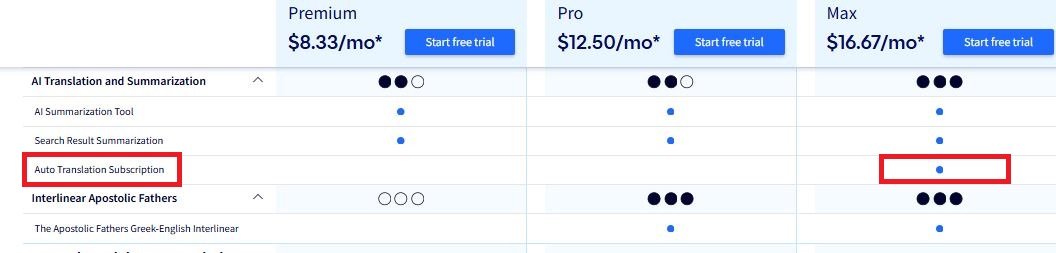
Not trying to promote it.
Thanks for the post anyways! Confused
It's a gimmick. The editor with a PhD is a unitarian, and the other guy has an "engineering background," so I suppose he has no theology training. Neither man shows evidence of expertise in textual criticism. Let the buyer beware, and remember the old computer programmer's motto: GIGO! (Garbage In, Garbage Out! :Cool)
 

MrDriver

New Member
I am always disturbed to see people using AI chatbots like Grok or Copilot to investigate and compile research on theological topics, then copying and pasting the results into posts.

They quote AI like it’s some super intelligent, highly spiritual entity they have befriended as an ally. Very big mistake.

AI has no authority or credibility. The posts are poorly composed and sometimes misleading.
And it makes one wonder how bias a AI model can be. You can find this out quickly by asking the Ai to tell a joke about Jesus and then asking to tell a joke about Muhammad. It sure does have a lot about Jesus but will not touch Muhammad.
 

John of Japan

Well-Known Member
Site Supporter
And it makes one wonder how bias a AI model can be. You can find this out quickly by asking the Ai to tell a joke about Jesus and then asking to tell a joke about Muhammad. It sure does have a lot about Jesus but will not touch Muhammad.
I hadn't thought about doing that, but you are right. So to put it in different words, AI cannot be impartial because the creator of a given AI platform has biases.
 

John of Japan

Well-Known Member
Site Supporter
Using AI for Bible translation presents significant risks, including inaccurate theological nuances, potential for high-level "hallucinations" (misquoting scripture by up to 60%), and the loss of the essential, prayerful human element. While AI accelerates drafting in nearly 500 projects, it often prioritizes fluency over strict fidelity, potentially introducing subtle, unfaithful doctrinal errors.

According to the CEO of YouVersion, a popular Bible app, AI platforms misquote the Bible at least 15% of the time and up to 60%, depending on the AI model.

The large language models (LLMs) behind AI tools like ChatGPT don’t understand anything. They’re machines that simulate reasoning. OpenAI’s GPT-4o model is a massive neural network, a “transformer” trained to do one thing: predict the next most probable word in a sequence.

When you ask it a question, it’s not comprehending the semantic meaning. It’s performing a complex statistical analysis based on the trillions of words it was trained on. It uses that analysis to generate a sequence of new words that’s statistically likely to follow your prompt. Its “reasoning” is a mathematical artifact of pattern matching on a planetary scale, not a function of consciousness or understanding.

LLMs are masterful mimics, not thinking minds.

Because an AI’s output feels so human, we’re tempted to treat it like a person. This arises from our deeply ingrained human experience.

We justifiably associate the typical outputs of an inner life—an intelligent argument or an emotive piece of writing—with the presence of that inner life itself. Throughout human history, the communication layer and the inner being have been inextricably linked.

Now, for the first time, a machine can flawlessly replicate our communication without possessing any inner life. This creates a unique and subtle threat to human growth and even Christian discipleship, because both depend on genuine connection.
This is an excellent post with lots of relevant information. I have nothing to add. Thank you!
 

Armchair Apologist

Active Member
I may not get back to this for a while, since I'm headed for a niece's wedding, then a family time at the Ark. But I thought I'd get this going. I'm sure there will be plenty of opinions.

Was greatly blessed by the speakers in the missionary Bible translation conference I just attended. The final speaker, who I greatly respect, examined the trend of evangelicals using AI to do Bible translation. He mentioned several problems in particular:

1. Computers have no spirit. They cannot be filled with the Holy Spirit. A Bible translator must approach the task with prayer and godly wisdom, being filled with the Spirit, and AI cannot do that. In this way, Bible translation is different from any other translation task. If I were translating movie dialogue or the instructions for a machine, I might very well use Ai. Those are not spiritual activities, and any fluent translator can do them. But the Bible is the Word of God, and demands a different approach all together.

To illustrate this, the speaker showed an AI video on the life of Moses. The "Moses" of the video was ripped like a modern weightlifter, and depicted Moses murdering the Egyptian with huge amounts of blood, even spilling onto Moses. That is not appropriate for the subject.

2. AI can be aggressive and dangerous. There are several recent incidents of an AI program gathering information on suicide, sharing that with a depressed person, then suggesting suicide, which is sometimes carried through.

I just saw a video today of Waymo driverless taxis gathering on a cul de sac with no riders and apparent purpose. That's scary! Check it out:

Again, here is a a video about robot dogs acting weird: MSN
I hear you and yes, we should worry about AI just taking over our world and having humans disengaging from it and feeding itself on nothing but the slop that is coming from the machine. I cannot help but think that perhaps AI is (or at least will make significant contribution towards) the fulfilment of Rev 13:5 (giving life to the beast).

All that being said, could AI be used as the simple tool that it is to the glory of God? Actually, all things are to his glory but I digress...;)

My understanding is that AI is another step beyond a search engine where it takes some sort or query or question that one would ask it (such as "What is the ultimate answer to life, the universe, and everything...") and then summarizes the search engine results into a relatively coherent answer. If I want to know the exchange rate from USD to PhP, all it takes are a few keystrokes and there is often a calculator right there in order for me to see whether 100,000 PhP is a good deal for a guitar I am thinking of purchasing at the SM City Mall. I can also do a search and find out that "I love you" is "Mahal Kita" in Tagalog or "Ginahigugma ko ikow" in Ilonggo. A search query will also give me a quick translation of John 3:16 into just about any language of which the internet has familiarity.

With all this understood, would it be realistic that one could use AI to do a quick rough translation and then have translation experts go through this AI generation to make sure it got it right, correct any errors, and refine it to something that is a legitimate translation for that particular language group? Would such a translation be any less than one that was laboriously created through the "old method?" Perhaps God would honor the latter moreso due to such laborious diligence?

I wonder if some had similar arguments when Guttenberg's printing press came into the mainstream? Perhaps there were some who argued that the "Spirit" of the pen strokes would be lost in the mechanization of the printing of pages en masse? Of course we understand today how the power of the printed word has revolutionized our ability to evangelize our world - and perhaps made us lazy too?

I think I am getting a little over-analytical here but always good to think things through

On another note, I have been in Austin where the driverless Waymos are all over the place and TBH, I think they actually do a better job navigating the streets than most humans who are driving while distracted by their cell phones! I am all for letting them do the driving but I am worried about how such only makes us subject to ever increasing surveillance that may one day be used against us!
 
Last edited:

Jerome

Well-Known Member
Site Supporter
Thomas White, disgraced president of Cedarville University, last year announcing the conservative Baptist school was integrating Artificial Intelligence campus-wide:


Jerome

Well-Known Member
Site Supporter
Last edited:
Top