Anthony Pritchard
Well-Known Member
A Childhood Shaped by Fear and the Men Who Quieted It
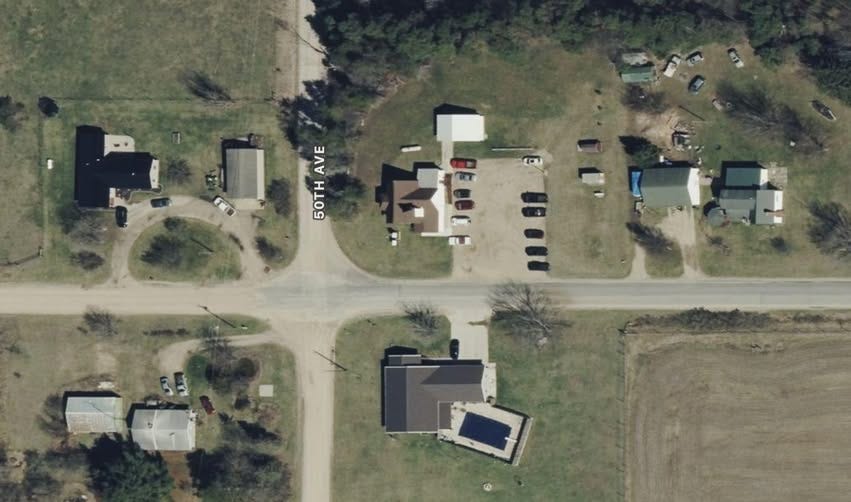
I was seven years old in a one room schoolhouse in Sylvan Township Michigan, a place where the gravel on 50th Avenue made more noise than the children did. We did not call it 50th Avenue back then. It was just the road that ran north and south and I did not know the name, Sylvan Road ran east and west past my house, the township hall and the school. The house on the northwest corner of the intersection, shown in the photo, had not always been there. My dad and granddad moved it from just outside Evart in 1960. The house itself was free to anyone willing to move it, and they took the offer. They hired a man with a low trailer, big enough to haul a two room house, but the hard work was still theirs. I remember my dad digging up the old pier foundation by hand with a shovel. I remember him jacking the house up with house jacks, inch by inch, until it stood high enough for the trailer to slide under it. He dug a sloping entryway so the trailer could be backed in at the right angle, all by hand with a shovel. When the day came to move the house, he rode on the roof with a wooden pole to lift the power and telephone lines that crossed the road so the house could clear them. The house was simple back then, only two rooms. We divided the bedrooms with curtains because there were no walls. We had an artesian well that gave us cold running water to the kitchen sink and nowhere else. We had no bathroom, only an outhouse behind the house. The home that stands there today is very modern compared to what it was when we lived in it. The rest of the farm stretched north behind it, fields and pasture and barns that had been worked by our family for years.
The school sat on the north side of Sylvan Road, right where the green roofed house stands today. It was a simple wooden building with tall windows that rattled in the winter wind and a stove that kept us warm when the snow piled up outside. Across from the township hall stood Chase’s General Store with its wooden porch and its jars of penny candy. It was the center of our small world.
Sylvan Corners was seven miles from Evart, which we thought of as a city. It had just over a thousand people, but to us it was big. It had stores and lights and traffic and a main street that felt important. I was certain that if the Russians ever launched their missiles, Evart would be a target. I imagined men in Moscow pointing at maps and circling our little town with red pencils. I imagined Sylvan Township caught in the blast. It made no sense, but fear rarely does, especially in the mind of a child.
We did not have a siren for nuclear drills. We had a bell on a rope. The same bell that called us in from recess was the one that told us to get under our desks. The teacher rang it in a sharp, quick way that was different from anything else. When we heard that sound, we knew what to do.
We slid from our seats and crawled under our desks. Mine was made of oak and weighed more than I did. I believed it was strong. I believed it could protect me. I believed it could stop whatever danger the adults were worried about. I did not understand blast pressure or shock waves, but I knew enough to be frightened. We all did. We had heard the words nuclear war. We had heard the word missile. We had seen pictures in Weekly Reader of rockets that could cross oceans. We knew that somewhere far away there were men who could push buttons that would change everything.
So I made my own plan. If the bomb ever fell on Sylvan Township, I decided I would run to Chase’s small general store, just beside the Township Hall, after the blast. I imagined the penny candy scattered across the ground by the shock wave. I thought I could pick up all the candy I wanted before anyone stopped me. It was a strange thought, but it made sense to a child who knew just enough to be scared and not enough to understand the scale of destruction.
I remember the smell of chalk under the desk. I remember the cold floorboards. I remember the stove ticking as it cooled. I remember the wind pushing against the tall windows. I remember believing that oak could stop the fire of the sun.
Years later I learned the truth. The desk would not have saved us. The drill was not protection. It was a ritual to give the adults a sense of control in a world where they had very little. And I learned that Sylvan Corners was never a target. Moscow did not have a map of Sylvan with red targeting circles and arrows. There was nothing there that Moscow cared about. No factories. No bases. No cities. Just farms, fields, a schoolhouse, a township hall, and a small store with penny candy. But to a Second Grad boy, it was real, and I was certain that my desk could protect me from a nuclear blast.
My dad and granddad never talked much about fear. They were men who solved problems with their hands and their backs, not with long conversations. When they moved that house, they did it the way men of that time did everything. They worked until the job was done. They did not hire a company. They did not draw up plans. They simply decided it could be done and then did it. Watching them taught me more about courage than any drill ever could.
Looking back, I think that steady confidence was the real shelter of my childhood. Not the oak desk. Not the bell on the rope. It was the sight of my dad and granddad doing what needed to be done without complaint and without fear. They lived in the same world I did, a world where the news spoke of missiles and megatons, but they did not let that shadow rule their days. They built, they worked, they moved houses, they raised families, and they trusted that life was still worth living even with the threat hanging overhead.
As a child, I believed the Russians had a target right above Sylvan Corners. I believed that Evart was a city important enough to be circled on a map in Moscow. I believed that my oak desk could stop the fire of the sun. Those fears felt large because I was small.
Now, standing at the same crossroads as an adult, I see the truth. The world was dangerous, but not in the way I imagined. The threat was real, but so was the strength of the people who raised me. The desk would not have saved me, but the example of my dad and granddad did. They taught me that fear does not get the last word.
~Tony
© A.K. Pritchard 1960 -