The Origin of the Old-earth Worldview
Prior to the 1700s, few believed in an old earth. The approximate 6,000-year age for the earth was challenged only rather recently, beginning in the late 18th century. These opponents of the biblical chronology essentially left God out of the picture. Three of the old-earth advocates included Comte de Buffon, who thought the earth was at least 75,000 years old. Pièrre LaPlace imagined an indefinite but very long history. And Jean Lamarck also proposed long ages.
11
However, the idea of millions of years really took hold in geology when men like Abraham Werner, James Hutton, William Smith, Georges Cuvier, and Charles Lyell used their interpretations of geology as the standard, rather than the Bible. Werner estimated the age of the earth at about one million years. Smith and Cuvier believed untold ages were needed for the formation of rock layers. Hutton said he could see no geological evidence of a beginning of the earth; and building on Hutton’s thinking, Lyell advocated “millions of years.”
From these men and others came the consensus view that the geologic layers were laid down slowly over long periods of time based on the rates at which we see them accumulating today. Hutton said:
The past history of our globe must be explained by what can be seen to be happening now. . . . No powers are to be employed that are not natural to the globe, no action to be admitted except those of which we know the principle.
12
This viewpoint is called naturalistic uniformitarianism, and it excludes any major catastrophes such as Noah’s flood. Though some, such as Cuvier and Smith, believed in multiple catastrophes separated by long periods of time, the uniformitarian concept became the ruling dogma in geology.
Thinking biblically, we can see that the global flood in Genesis 6–8 would wipe away the concept of millions of years, for this Flood would explain massive amounts of fossil layers. Most Christians fail to realize that a global flood could rip up many of the previous rock layers and redeposit them elsewhere, destroying the previous fragile contents. This would destroy any evidence of alleged millions of years anyway. So the rock layers can theoretically represent the evidence of either millions of years or a global flood, but not both. Sadly, by about 1840, even most of the Church had accepted the dogmatic claims of the secular geologists and rejected the global flood and the biblical age of the earth.
After Lyell, in 1899, Lord Kelvin (William Thomson) calculated the age of the earth, based on the cooling rate of a molten sphere, at a maximum of about 20–40 million years (this was revised from his earlier calculation of 100 million years in 1862).
13 With the development of radiometric dating in the early 20th century, the age of the earth expanded radically. In 1913, Arthur Holmes’s book,
The Age of the Earth, gave an age of 1.6 billion years.
14 Since then, the supposed age of the earth has expanded to its present estimate of about 4.5 billion years (and about 14 billion years for the universe).
Table 5. Summary of the Old-earth Proponents for Long Ages
Who? Age of the Earth When Was This?
Comte de Buffon 78 thousand years old 1779
Abraham Werner 1 million years 1786
James Hutton Perhaps eternal, long ages 1795
Pièrre LaPlace Long ages 1796
Jean Lamarck Long ages 1809
William Smith Long ages 1835
Georges Cuvier Long ages 1812
Charles Lyell Millions of years 1830–1833
Lord Kelvin 20–100 million years 1862–1899
Arthur Holmes 1.6 billion years 1913
Clair Patterson 4.5 billion years 1956
But there is growing scientific evidence that radiometric dating methods are completely unreliable.
15
Christians who have felt compelled to accept the millions of years as fact and try to fit them into the Bible need to become aware of this evidence. It confirms that the Bible’s history is giving us the true age of the creation.
Today, secular geologists will allow some catastrophic events into their thinking as an explanation for what they see in the rocks. But uniformitarian thinking is still widespread, and secular geologists will seemingly never entertain the idea of the global, catastrophic flood of Noah’s day.
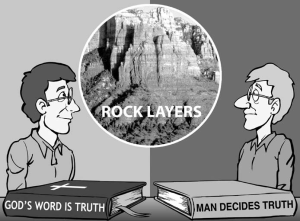
The age of the earth debate ultimately comes down to this foundational question: Are we trusting man’s imperfect and changing ideas and assumptions about the past? Or are we trusting God’s perfectly accurate eyewitness account of the past, including the creation of the world, Noah’s global flood, and the age of the earth?
How Old Is the Earth?