• Welcome to Baptist Board, a friendly forum to discuss the Baptist Faith in a friendly surrounding.

    Your voice is missing! You will need to register to get access to all the features that our community has to offer.

    We hope to see you as a part of our community soon and God Bless!

Genesis 1:16 and its added words.

FollowTheWay

Well-Known Member
Site Supporter
We should do and interpret science THROUGH THE LENS of Scripture. Not the other way around.
Let's for a minute suppose that the Big Bang theory is correct. Not many people in today's world understand it. How would God have described it to early man? It's not anti-Biblical to assume that God impacts us using natural forces. We don't understand these entirely and never will until we see Him face to face. Do you claim to understand the ways of God?
 

FollowTheWay

Well-Known Member
Site Supporter
We should do and interpret science THROUGH THE LENS of Scripture. Not the other way around.
Where did "the waters" described in verse 2 come from? This was before God created anything.
What was the source of the light created on Day 1 if not the sun and stars?
 

Van

Well-Known Member
Site Supporter
Your issue was with light in transit.

No the issue was not "light in transit."

Van said:
My difficulty with the "light in transit" solution is why was the light which arrived 6 thousand years later, created to show a supernova that occurred perhaps 165,000 years ago. The creation of "apparent history" solves all the problems, but that does not mean it is truth, only convenient.
 

Van

Well-Known Member
Site Supporter
What if a book came out claiming the earth was not 6000 years old or 4-5 billion years old, but was between 1.2 billion years and 2 billion years old. Could this new science be interpreted to be consistent with scripture? Yes.

What if a book came out claiming humankind was not 6000 years old or hundreds of thousands of years old, but was 50 to 70 thousand years old. Could this new science be interpreted to be consistent with scripture? Nope Scripture says Adam was the first man and he lived about 6000 years ago.
 
This is just my opinion, and it’s worth about what you paid for it...but I believe scripture is the standard of truth that everything else should be reconciled to. Not the other way around.
 

atpollard

Well-Known Member
Strictly my opinion, but to read Genesis 1 as some sort of Historic Narrative or Astronomy/Geology text book is to miss the purpose and the true message of Genesis 1. I see Genesis 1 as a polemic aimed directly at refuting all of the polytheistic creation myths that dominated the thinking of all of the cultures around God’s chosen people. Egypt, India, Babylon, the Persians ... all shared certain similarities and had subtle differences. Genesis 1 openly declares war on all other ‘gods’ and creation myths by directly contradicting all of them in all of the critical details.

All other cultures begin with a story of SOMETHING existing, often chaos or water, and how one ‘god’ was created from the chaos/water and then that ‘god’ created all of the other ‘gods’. Genesis 1 begins with God already eternally existing, there was no story of the creation of God because God was not created. God always existed. God does not come from the chaos/water, God is above the chaos/water. God does not create everything from some already existing SOMETHING, God creates from nothing, speaking reality into existence.

You focus on the ‘day and night’ of day 1 and worry about the science of when the sun and stars are created. I think that God creating LIGHT and DARKNESS before there was a sun or stars is part of the point. Think about how many times the analogy of Light and Darkness will be used in scripture after the writing of Genesis 1. It is an important THEOLOGICAL distinction that God, and not the sun is the ultimate source of light. In the new “Heaven and earth” of Revelation, there will be no sun. God will illuminate His holy city.

Can you see the polemic? Beginning to end, God is the source of our light. It has nothing to do with understanding physical reality, and everything to do with understanding the more important spiritual reality.
 

church mouse guy

Well-Known Member
Site Supporter
The current view of science is that the earth is about 13.8 billion years old. You wouldn't say it is 1 trillion years old because there is no evidence to back that up.

No, you are behind the times. The telescope in space discovered even more distant stars. Using the speed of light, there is not enough time for the starlight to cross the universe in 14 billion years. You need to check your math and do a new calculation.
 

church mouse guy

Well-Known Member
Site Supporter
The Origin of the Old-earth Worldview
Prior to the 1700s, few believed in an old earth. The approximate 6,000-year age for the earth was challenged only rather recently, beginning in the late 18th century. These opponents of the biblical chronology essentially left God out of the picture. Three of the old-earth advocates included Comte de Buffon, who thought the earth was at least 75,000 years old. Pièrre LaPlace imagined an indefinite but very long history. And Jean Lamarck also proposed long ages.11

However, the idea of millions of years really took hold in geology when men like Abraham Werner, James Hutton, William Smith, Georges Cuvier, and Charles Lyell used their interpretations of geology as the standard, rather than the Bible. Werner estimated the age of the earth at about one million years. Smith and Cuvier believed untold ages were needed for the formation of rock layers. Hutton said he could see no geological evidence of a beginning of the earth; and building on Hutton’s thinking, Lyell advocated “millions of years.”

From these men and others came the consensus view that the geologic layers were laid down slowly over long periods of time based on the rates at which we see them accumulating today. Hutton said:

The past history of our globe must be explained by what can be seen to be happening now. . . . No powers are to be employed that are not natural to the globe, no action to be admitted except those of which we know the principle.12
This viewpoint is called naturalistic uniformitarianism, and it excludes any major catastrophes such as Noah’s flood. Though some, such as Cuvier and Smith, believed in multiple catastrophes separated by long periods of time, the uniformitarian concept became the ruling dogma in geology.

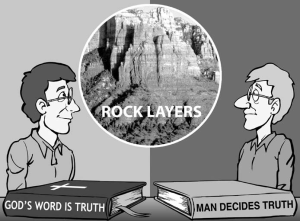
gods-word-truth.gif

Thinking biblically, we can see that the global flood in Genesis 6–8 would wipe away the concept of millions of years, for this Flood would explain massive amounts of fossil layers. Most Christians fail to realize that a global flood could rip up many of the previous rock layers and redeposit them elsewhere, destroying the previous fragile contents. This would destroy any evidence of alleged millions of years anyway. So the rock layers can theoretically represent the evidence of either millions of years or a global flood, but not both. Sadly, by about 1840, even most of the Church had accepted the dogmatic claims of the secular geologists and rejected the global flood and the biblical age of the earth.

After Lyell, in 1899, Lord Kelvin (William Thomson) calculated the age of the earth, based on the cooling rate of a molten sphere, at a maximum of about 20–40 million years (this was revised from his earlier calculation of 100 million years in 1862).13 With the development of radiometric dating in the early 20th century, the age of the earth expanded radically. In 1913, Arthur Holmes’s book, The Age of the Earth, gave an age of 1.6 billion years.14 Since then, the supposed age of the earth has expanded to its present estimate of about 4.5 billion years (and about 14 billion years for the universe).

Table 5. Summary of the Old-earth Proponents for Long Ages

Who? Age of the Earth When Was This?
Comte de Buffon 78 thousand years old 1779
Abraham Werner 1 million years 1786
James Hutton Perhaps eternal, long ages 1795
Pièrre LaPlace Long ages 1796
Jean Lamarck Long ages 1809
William Smith Long ages 1835
Georges Cuvier Long ages 1812
Charles Lyell Millions of years 1830–1833
Lord Kelvin 20–100 million years 1862–1899
Arthur Holmes 1.6 billion years 1913
Clair Patterson 4.5 billion years 1956
But there is growing scientific evidence that radiometric dating methods are completely unreliable.15

Christians who have felt compelled to accept the millions of years as fact and try to fit them into the Bible need to become aware of this evidence. It confirms that the Bible’s history is giving us the true age of the creation.

Today, secular geologists will allow some catastrophic events into their thinking as an explanation for what they see in the rocks. But uniformitarian thinking is still widespread, and secular geologists will seemingly never entertain the idea of the global, catastrophic flood of Noah’s day.

The age of the earth debate ultimately comes down to this foundational question: Are we trusting man’s imperfect and changing ideas and assumptions about the past? Or are we trusting God’s perfectly accurate eyewitness account of the past, including the creation of the world, Noah’s global flood, and the age of the earth?

How Old Is the Earth?

One thing that Dr. Terry Mortensen notes in his book The Great Turning Point is that Buffon, Werner, Hutton, Laplace, Lamarck, Smith, Cuvier, and Lyell were all deists or atheists. So it is clear that they were making an attack on Christianity and Judaism. Dr. Mortensen is an expert in the history of geology and has studied this time frame better than anyone else in my opinion. He is the one who spent a couple of years in England tracking down the preachers in the early 19th century who stood against evolution and its corollary of deep time. I was blessed to see him at the Creation Museum during a Friday lunchtime lecture in Legacy Hall where he discussed this issue. Don't let anyone tell you that YECs are not highly-educated and highly scientific.


Van

Well-Known Member
Site Supporter
This is just my opinion, and it’s worth about what you paid for it...but I believe scripture is the standard of truth that everything else should be reconciled to. Not the other way around.
It is great to hold opinions, I have a whole sack of them. The issue in my opinion is our differing opinions of interpretation of scripture.

In my opinion we do not know how old creation is, we were not there. Job 38. But on the other hand, we do know about when Adam was created, because we have the whole list of generations, and using the times given in scripture for the early part of the list, and the time from David to Jesus (about 1000 years) and if we allow the longest average generation time from either known part, we come up with about 6000 years ago.

Therefore, in accordance with your opinion, I believe science has wrongly dated all the evidence, such as cave paintings, for early man if they claim it occurred much before 6000 years ago.
 

FollowTheWay

Well-Known Member
Site Supporter
Strictly my opinion, but to read Genesis 1 as some sort of Historic Narrative or Astronomy/Geology text book is to miss the purpose and the true message of Genesis 1. I see Genesis 1 as a polemic aimed directly at refuting all of the polytheistic creation myths that dominated the thinking of all of the cultures around God’s chosen people. Egypt, India, Babylon, the Persians ... all shared certain similarities and had subtle differences. Genesis 1 openly declares war on all other ‘gods’ and creation myths by directly contradicting all of them in all of the critical details.

All other cultures begin with a story of SOMETHING existing, often chaos or water, and how one ‘god’ was created from the chaos/water and then that ‘god’ created all of the other ‘gods’. Genesis 1 begins with God already eternally existing, there was no story of the creation of God because God was not created. God always existed. God does not come from the chaos/water, God is above the chaos/water. God does not create everything from some already existing SOMETHING, God creates from nothing, speaking reality into existence.

You focus on the ‘day and night’ of day 1 and worry about the science of when the sun and stars are created. I think that God creating LIGHT and DARKNESS before there was a sun or stars is part of the point. Think about how many times the analogy of Light and Darkness will be used in scripture after the writing of Genesis 1. It is an important THEOLOGICAL distinction that God, and not the sun is the ultimate source of light. In the new “Heaven and earth” of Revelation, there will be no sun. God will illuminate His holy city.

Can you see the polemic? Beginning to end, God is the source of our light. It has nothing to do with understanding physical reality, and everything to do with understanding the more important spiritual reality.
I understand and accept the theological importance of the story of creation in Gen. 1. In fact that's the point I'm making. The Bible is all about theology and our relationship with God. It is not a science textbook.
 

Revmitchell

Well-Known Member
Site Supporter
The Bible is not a science textbook but when it speaks to history and to creation and science it is absolutely correct.
 

FollowTheWay

Well-Known Member
Site Supporter
One thing that Dr. Terry Mortensen notes in his book The Great Turning Point is that Buffon, Werner, Hutton, Laplace, Lamarck, Smith, Cuvier, and Lyell were all deists or atheists. So it is clear that they were making an attack on Christianity and Judaism. Dr. Mortensen is an expert in the history of geology and has studied this time frame better than anyone else in my opinion. He is the one who spent a couple of years in England tracking down the preachers in the early 19th century who stood against evolution and its corollary of deep time. I was blessed to see him at the Creation Museum during a Friday lunchtime lecture in Legacy Hall where he discussed this issue. Don't let anyone tell you that YECs are not highly-educated and highly scientific.

Just as in the general population, there have been great scientists who not Christians and equally great scientists who were Christian.
Sample of Famous Artists and Scientists who were Christians
Sir Frances Bacon

Robert Boyle

George Washington Carver

Samuel Taylor Coleridge

Nicolaus Copernicus

Leonhard Euler

Michael Faraday

Johannes Kepler

Father Georges-Henri LeMaitre

Carolus Linnaeus

Matthew Fontaine Maury

James Clerk Maxwell

Gregor Mendel

Samuel F. D. Morse

Sir Isaac Newton

Blaise Pascal

Louis Pasteur

Sir James Young Simpson, Founder of gynecology and modern anesthesiology

Nicolaus Steno, Father of Stratigraphy

and many more ...

Of the ones you cited, the only one I've ever heard of is LaPlace. On my list are Robert Boyle, Copernicus, Faraday, Kepler, Maxwell, Mendel, Sir Isaac Newton, Pascal, Pasteur..... All of these were giants in the history of science.
 

FollowTheWay

Well-Known Member
Site Supporter
No, you are behind the times. The telescope in space discovered even more distant stars. Using the speed of light, there is not enough time for the starlight to cross the universe in 14 billion years. You need to check your math and do a new calculation.
This is what's on the NASA web site:
NASA: 60 Years & Counting - Mysteries of the Universe

The Age of the Universe
The Wilkinson Microwave Anisotropy Probe (WMAP) satellite returned data that allowed astronomers to precisely assess the age of the universe to be 13.77 billion years old and to determine that atoms make up only 4.6 percent of the universe, with the remainder being dark matter and dark energy. Using telescopes like Hubble and Spitzer, scientists also now know how fast the universe is expanding.

What's your source?
 

church mouse guy

Well-Known Member
Site Supporter
This is what's on the NASA web site:
NASA: 60 Years & Counting - Mysteries of the Universe

The Age of the Universe
The Wilkinson Microwave Anisotropy Probe (WMAP) satellite returned data that allowed astronomers to precisely assess the age of the universe to be 13.77 billion years old and to determine that atoms make up only 4.6 percent of the universe, with the remainder being dark matter and dark energy. Using telescopes like Hubble and Spitzer, scientists also now know how fast the universe is expanding.

What's your source?

Distant Starlight
 

church mouse guy

Well-Known Member
Site Supporter
Just as in the general population, there have been great scientists who not Christians and equally great scientists who were Christian.
Sample of Famous Artists and Scientists who were Christians
Sir Frances Bacon

Robert Boyle

George Washington Carver

Samuel Taylor Coleridge

Nicolaus Copernicus

Leonhard Euler

Michael Faraday

Johannes Kepler

Father Georges-Henri LeMaitre

Carolus Linnaeus

Matthew Fontaine Maury

James Clerk Maxwell

Gregor Mendel

Samuel F. D. Morse

Sir Isaac Newton

Blaise Pascal

Louis Pasteur

Sir James Young Simpson, Founder of gynecology and modern anesthesiology

Nicolaus Steno, Father of Stratigraphy

and many more ...

Of the ones you cited, the only one I've ever heard of is LaPlace. On my list are Robert Boyle, Copernicus, Faraday, Kepler, Maxwell, Mendel, Sir Isaac Newton, Pascal, Pasteur..... All of these were giants in the history of science.

The people cited first by Rev. Mitchell are the early deists and atheists at the beginning of the European Enlightenment and the first people of recent times to attack Christianity with the notion of deep time. Lyell, a British lawyer, was read by Darwin on his voyage. The others were well-known in France, Germany, and England has the new science of geology was begun. So the ones cited above were the early supporters of Darwin and the evolutionary corollary of deep time. The Church in England and America put up some resistance but by the middle of the nineteenth century the baton fell to the ground not to be picked up again until 1961 by Dr. Henry Morris and Dr. John Whitcomb (of Indianapolis now) with their book Genesis Flood. which led with some certainty to construction of the Ark Encounter in Williamstown, Kentucky, a few years after the opening of the Creation Museum in Petersburg, Kentucky. So I have expanded your list of Christian scientists with Young Earth Creationists.
 

FollowTheWay

Well-Known Member
Site Supporter
This is what your "science expert" says:
."In fact, Einstein tells us that, if a person could travel at the speed of light, then the trip would be completely instantaneous (from his or her point of view)."

That should be a BIG IF because:
The theory says it can't happen, so obviously the theory has nothing to say if it did happen.

Einstein said about such scenarios, "our deliberations are meaningless."

This part of your source I believe:
"We should also remember that God is not limited to natural methods as we are."


Personally, I believe that there are different types of literature in the Bible (history, science, law, glorification, gospel, prophesy, etc.) and these need to be interpreted differently. Certainly, the Bible needs to be interpreted in its historical context. There are a lot of cases in which something said in the 1st century AD would be interpreted differently in the 21st century AD.
 

FollowTheWay

Well-Known Member
Site Supporter
The people cited first by Rev. Mitchell are the early deists and atheists at the beginning of the European Enlightenment and the first people of recent times to attack Christianity with the notion of deep time. Lyell, a British lawyer, was read by Darwin on his voyage. The others were well-known in France, Germany, and England has the new science of geology was begun. So the ones cited above were the early supporters of Darwin and the evolutionary corollary of deep time. The Church in England and America put up some resistance but by the middle of the nineteenth century the baton fell to the ground not to be picked up again until 1961 by Dr. Henry Morris and Dr. John Whitcomb (of Indianapolis now) with their book Genesis Flood. which led with some certainty to construction of the Ark Encounter in Williamstown, Kentucky, a few years after the opening of the Creation Museum in Petersburg, Kentucky. So I have expanded your list of Christian scientists with Young Earth Creationists.
You said these people were "deists and atheists" not Young Earth Creationists. Which is it?
 
Top