• Welcome to Baptist Board, a friendly forum to discuss the Baptist Faith in a friendly surrounding.

    Your voice is missing! You will need to register to get access to all the features that our community has to offer.

    We hope to see you as a part of our community soon and God Bless!

Predestination unto salvation

Status
Not open for further replies.

Reformed1689

Well-Known Member
@davidtaylorjr ,

To be fair, "foreknowledge" can mean precognition. To "know" is also a way to indicate sexual relations (which could refer to intimate knowledge).

Personally I like John Calvin's justification for foreknowledge as it relates to predestination. I think that he gets to the same place without making the meaning of the word an issue of debate. In Institutes Calvin argues that "foreknowledge" means precognition (God's pre-knowledge). BUT Calvin bases this pre-knowledge on God's decree (God's foreknowledge is centered on God's sovereignty).
I agree, which is why you must look at how it is specifically used in context. It has a different nuance in this passage which nearly all technical lexicons agree.
 

Iconoclast

Well-Known Member
Site Supporter
George Antonios,

Hello G.A.

Sorry for the delay but I am settled in now.
I give you credit for trying to back up your ideas from attempting to link together scripture passages.
that is more than most will attempt so thanks for using scripture. the question is what is taught and what is not.

You brethren keep reading this as if to be conformed to the image of his Son (Rom.8:29) means "to obtain eternal life". It doesn't mean that at all. [/QUOTE]

If your premise is that this passage is not speaking of salvation, that is flat out wrong. Easily shown to be false by the language of the passage.

30 Moreover whom he did predestinate, them he also called: and whom he
called, them he also justified: and whom he justified,
them he also
glorified.

The unsaved are not called, justified, or glorified. The passage is speaking of all three. Kyred was correct when he answered you.

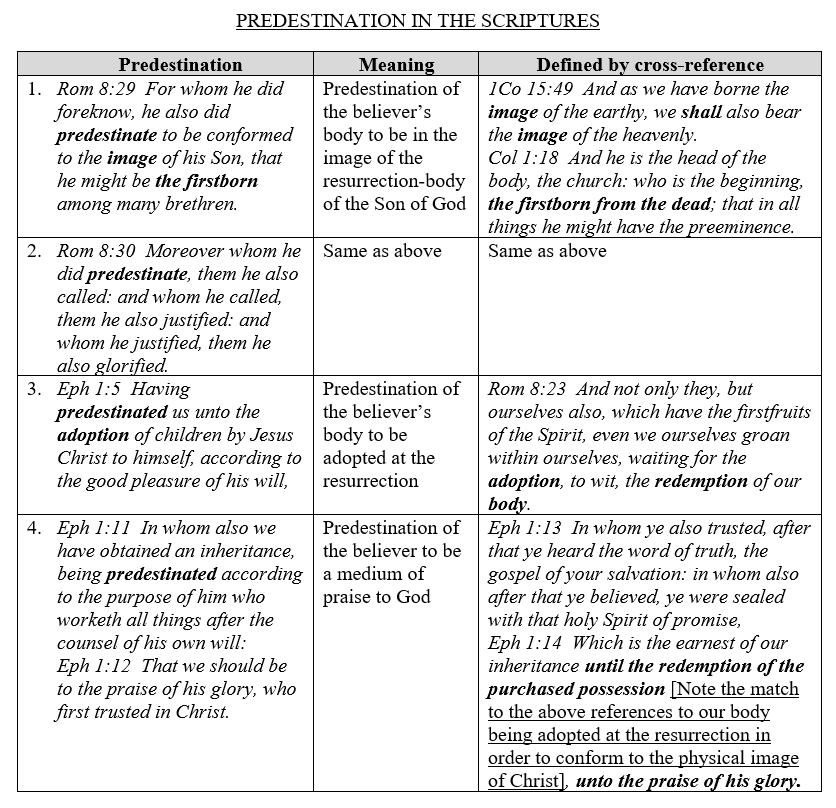
Now your chart seeks to identify just the physical condition of these predestined persons.


Paul defined his own terms.
He is saying that every believer has been predetermined of God to obtain a resurrection body like unto the Son's resurrection body.
View attachment 3531 Brethren, that's how Paul himself defined Romans 8:29.
No...everyone gets a resurrection body, the saved as well as the unsaved.

jn5:
28 Marvel not at this: for the hour is coming, in the which all that are in the graves shall hear his voice,

29 And shall come forth; they that have done good, unto the resurrection of life; and they that have done evil, unto the resurrection of damnation.
Our glorified body is part of our eternal inheritance, but we are not isolated from our spirit.
 

JonC

Moderator
Moderator
I agree, which is why you must look at how it is specifically used in context. It has a different nuance in this passage which nearly all technical lexicons agree.
I agree.

This is one thing that has been detrimental about so many word studies. I have seen people take a word as if it was a code to be broken when in any language the meaning is typically determined by the context.

When I was in the Army I had two friends trying to get a language identifier for Spanish. One spoke Spanish as a child (English was his second language). The other took classes and went to Mexico on a mission trip. The one who grew up speaking the language failed the test while the other one got the identifier.

Sometimes the language at an academic level is too static and removed from the people using the language. Language is organic and context is very important.
 

Reformed1689

Well-Known Member
I agree.

This is one thing that has been detrimental about so many word studies. I have seen people take a word as if it was a code to be broken when in any language the meaning is typically determined by the context.

When I was in the Army I had two friends trying to get a language identifier for Spanish. One spoke Spanish as a child (English was his second language). The other took classes and went to Mexico on a mission trip. The one who grew up speaking the language failed the test while the other one got the identifier.

Sometimes the language at an academic level is too static and removed from the people using the language. Language is organic and context is very important.
For example, the eyes of the whole world are on this moment. What does the word world mean in that context? Context determines meaning.
 

Iconoclast

Well-Known Member
Site Supporter
JonC,
Now you have.

No I have not. You and other non cals do this very often.
You are trying to suggest, insinuate that Reformed . or Spurgeon or anyone else believes contradictory things when that is not the case at all..
How do you do it? Easy, you switch the topic of the discussion like this.

The term corporate election has a meaning among modern day non cals.
The idea being God elects the First Baptist church school bus, but no one in it. If anyone puts themselves on the bus, then they make themselves elect.

Those who wrote the 1689 confession of faith used the term to speak of individually elected Christians assembling to form the NT. Church a body of assembled believers. They were not concerned with the modern aberrations as no one was so foolish as to oppose true teaching.


Why do you believe @Reformed beleif that election is both corporate and individual is so preposterous and unbiblical?

I do not. I believe your twisted caricature is quite preposterous. By the time i finish posting this, reformed will most likely clarify his view.

[QUOTE]It makes sense to me. If the Church (the "elect") is not God's chosen people, if God truly has no Elect, but deals with people individually only then how do you explain the "Bride" or what has been discussed as the "Church" in terms of Reformed theology?[/QUOTE]

Again...I do not need you as my spokesman. You never quite get it right.
 

JonC

Moderator
Moderator
JonC,


No I have not. You and other non cals do this very often.
You are trying to suggest, insinuate that Reformed . or Spurgeon or anyone else believes contradictory things when that is not the case at all..
How do you do it? Easy, you switch the topic of the discussion like this.

The term corporate election has a meaning among modern day non cals.
The idea being God elects the First Baptist church school bus, but no one in it. If anyone puts themselves on the bus, then they make themselves elect.

Those who wrote the 1689 confession of faith used the term to speak of individually elected Christians assembling to form the NT. Church a body of assembled believers. They were not concerned with the modern aberrations as no one was so foolish as to oppose true teaching.


I do not. I believe your twisted caricature is quite preposterous. By the time i finish posting this, reformed will most likely clarify his view.

[QUOTE]It makes sense to me. If the Church (the "elect") is not God's chosen people, if God truly has no Elect, but deals with people individually only then how do you explain the "Bride" or what has been discussed as the "Church" in terms of Reformed theology?

In regards to me, you are wrong. I may not be a Calvinist but at one time I was (I understand Calvinism, perhaps better than you, as having held, formally studied, and taught the view).


In terms of @Reformed , he already answered for himself. I do not see that he has disagreed with my conclusion but I'll ask:

@Reformed ,

I stated that I believe election is both corporate and individual in the context that God has chosen for Himself a people (a "Bride", the "Church") and this people group is comprised of individually chosen people. In my opinion it is fair to call the Church "God's chosen people" or the "Elect" (corporately) and it is fair to say that the members of the Church (the Elect) were chosen from the foundation of the earth (they are individually elected). It starts individually, but very often Scripture refers to the Elect as a group as well.

I said that you do not have a flock without getting sheep.

Where do you disagree?

Jon
 

Iconoclast

Well-Known Member
Site Supporter
"George Antonios,
4776_cde72b465fd44b2da95cc4505c8f730a.gif
[/QUOTE]

Now the chart
1] It is not just the body image in view.
The image bearer doctrine was not about having a physical body itself,
God is Spirit.
It was Jesus who took upon himself the form of a servant. in the incarnation

2] you ignore that which pertains to salvation

3]adoption has to do with our rights as SonS

From A baptist catechism with Commentary, by WR.Downing-
Quest. 93: What is adoption? Ans: Adoption is an act of God’s free grace, whereby the believer is received into the number, and has a right to all the privileges of the sons of God, including the reception of the Holy Spirit. The full and final realization of adoption awaits the bodily resurrection unto glory.

COMMENTARY The Fatherhood of God is revealed in Scripture in several different filial relationships, none of which must be confused with the others: first, a
182
trinitarian or ontological filial relationship scripturally designated in terms of “Sonship.” The Lord Jesus Christ is God the Son, an ontological, eternal or generational Sonship, which is unique. See Questions 23 and 25. This designation distinguishes the second Person of the triune Godhead from the first and third Persons.
Second, a creational sonship, which includes angelic beings and human beings created by God as rational, moral, self–determining beings. Although all men are the children [“offspring’] of God in a creational sense, as bearing the Divine image (Gen. 1:26; Acts 17:28; Eph. 3:14–15; Jas. 3:9), this does not imply the “universal Fatherhood of God” and the “universal brotherhood of all men.” Such would deny the Fall, its consequences, the reality of sin and the necessity of redemption.

Third, a national sonship, which designated Israel under the Old Covenant (Ex. 4:22– 23; Rom. 9:4, 6–8). Fourth, a redemptive filial relation or sonship. This relationship is grounded in the sovereign love of God the Father (Eph. 1:3–5), through the mediatorial work of the Son (Gal. 4:4–6; Eph. 1:5–7), and evidenced by the ministry and witness of the Holy Spirit (Rom. 5:5; 8:14–17; Gal. 4:4–6). It is inseparable from regeneration and justification, and yet redemptively unique. It is this last sonship to which the biblical doctrine of adoption refers. The English term “adoption” derives from the Latin adoptio (from ad, “to” and opto, “choose”). The term occurs five times in Scripture, all in the New Testament, and all in the writings of Paul: Rom. 8:15, 23; 9:4; Gal. 4:5; Eph. 1:5. The Gk. term is huiothesia, from huios, “son,” and thesis, “a placing,” and literally means “to place as a son,” a process and ceremony upon one’s majority, which referred to natural sons within the family as well as to adopted sons from outside the family. One must take care not to read into the Scriptures either the bare Latin etymology, the legal, or the modern idea of adopting someone into the family as a child. The biblical terminology and its use designate this, but also much more. Adoption, then, is a distinct, forensic, separate and gracious act of God which brings us into that filial relationship and intimacy as his beloved sons and children. It is through adoption that we receive the Holy Spirit and the status of sonship (Rom. 8:14–17; Gal. 4:4–7). This forensic, gracious act of God—separate and distinct from regeneration and justification—stands at the foundation of our filial relationship to God as our Heavenly Father, and inclusively of our whole Christian experience. It is in the context of our adoption that we must consider our Father’s mercy and grace (Eph. 1:3–7; 2:18; 3:14–19), our relationship to him as “Father” (Gal. 4:5–7), our prayers to and communion with him (Matt. 6:9, 14–15; Lk. 11:2), his loving kindness, chastening and providential care (Rom. 8:14–17, 23, 28; Heb. 12:5–14), and that glorious presence, witness, seal and earnest of the Holy Spirit, who makes our Christian experience a reality, retains our glorious inheritance and preserves us unto his heavenly kingdom (Rom. 5:5; 8:15–16; Gal. 4:4–7; Eph. 1:13–14; 4:30; 2 Tim. 4:18; 1 Pet. 1:4).
183
Adoption possesses a vital eschatological aspect. The New Testament associates our final adoption [placing as a son] with our resurrection unto glory. Our resurrected, glorified bodies will signal our full and final status as the sons of God manifested before all creation (Rom. 8:17–23; Phil. 3:20

 

Iconoclast

Well-Known Member
Site Supporter
Are you saying that none of the 3000 saved at preaching by peter were born again? How can one be saved and not be born again?
George says election is not taught because it does not say it about each person individually. He wants to see a text. I asked him for a born again text in Acts.
 

JonC

Moderator
Moderator
@Iconoclast

Perhaps this will change your position:

The term "election" refers to God's choosing ("elected" is a fancy way of saying chosen).

Romans 11:5-7
In the same way then, there has also come to be at the present time a remnant according to God’s gracious choice... What Israel is seeking, it has not obtained, but those who were chosen obtained it

This renenint (a group) is according to God's choice (or election). Those (individuals) are chosen (elected) to obtain this grace.

I hope that helps. Just keep in mind when we say "elected" we are just talking about "chosen".

So the Church or Bride or "the Elect" are God's chosen people (as a group). Individuals in this group are chosen (individually). When Scripture speaks of the "Elect" it is not talking about one individual person but the Church.

Spurgeon preached a good sermon called "Choice Portions" where he specifically speaks of God's chosen people. If you are having difficulty perhaps that sermon will help explain the concept of a people chosen by God as a special possession. It is one of my favorite Spurgeon sermons.
 

Reformed

Well-Known Member
Site Supporter
@Reformed ,

I stated that I believe election is both corporate and individual in the context that God has chosen for Himself a people (a "Bride", the "Church") and this people group is comprised of individually chosen people. In my opinion it is fair to call the Church "God's chosen people" or the "Elect" (corporately) and it is fair to say that the members of the Church (the Elect) were chosen from the foundation of the earth (they are individually elected). It starts individually, but very often Scripture refers to the Elect as a group as well.

Jon, here is what I wrote earlier in this thread in post #64, "Election is both corporate (a people of God) and personal (individuals)." I also believe God created the Church which, as 26.1 of 1689 Second London Baptist Confession of Faith describes as, "the whole number of the elect, that have been, are, or shall be gathered into one, under Christ, the head thereof; and is the spouse, the body, the fulness of him that filleth all in all." Since "God's choosing" occurred from eternity, all that remains is for the elect to be effectually called in-time.

Each Christian is called individually but he is not called to remain as an individual. We are part of the New Covenant community.

1 Peter 2:9-10 9 But you are A CHOSEN RACE, A royal PRIESTHOOD, A HOLY NATION, A PEOPLE FOR God’s OWN POSSESSION, so that you may proclaim the excellencies of Him who has called you out of darkness into His marvelous light; 10 for you once were NOT A PEOPLE, but now you are THE PEOPLE OF GOD; you had NOT RECEIVED MERCY, but now you have RECEIVED MERCY.

The reason why most Monergists bristle at the term "Corporate Election" is that the term means different things to different people. If a Synergist is using the term it is according to free-will soteriology, where God creates the group first (i.e. "The Elect") and then populates the group with those who choose Him, similar in function as the "foreseen faith" view. Monergists, and specifically Reformed Christians, believe in a corporate aspect of election but not the creation of a group that is dependent on human choice. Since God is the One who predestines, the corporate body of Christ ("The Elect") are those whom He calls into the fold.

I hope this is making sense and we are not just going in circles. If it is the latter than the thread has outlived its usefulness.

*Edited to correct grammar and spelling.
 

Iconoclast

Well-Known Member
Site Supporter
JonC,

In regards to me, you are wrong. I may not be a Calvinist but at one time I was (I understand Calivinism, perhaps better than you, as having held, formally studied, and taught the view).

You can make that claim,but i certainly do not agree with you.
I would not trade my understanding for your misunderstanding.
You claim many things, but i and all the other cals read your posts.
I do not recall anyone saying what you say, or holding the opinion of your "supposed understanding " that you claim.
Howeve you are welcome to it. That is not the topic of the OP. neither am I.


Perhaps this will change your position:

The term "election" refers to God's choosing ("elected" is a fancy way of saying chosen).

Romans 11:5-7
In the same way then, there has also come to be at the present time a remnant according to God’s gracious choice... What Israel is seeking, it has not obtained, but those who were chosen obtained it

This renenint (a group) is according to God's choice (or election). Those (individuals) are chosen (elected) to obtain this grace.

I hope that helps. Just keep in mind when we say "elected" we are just talking about "chosen".
Helps what??? No one has asked you for help have they?:Sick:Cautious:oops:
I do not think anyone is worried that i do not know this teaching, so it seems as if you are making more of your smug comments under the "guise" of helping
 

Iconoclast

Well-Known Member
Site Supporter
Jon, here is what I wrote earlier in this thread in post #64, "Election is both corporate (a people of God) and personal (individuals)." I also believe God created the Church which, as 26.1 of 1689 Second London Baptist Confession of Faith describes as, "the whole number of the elect, that have been, are, or shall be gathered into one, under Christ, the head thereof; and is the spouse, the body, the fulness of him that filleth all in all." Since "God's choosing" occurred from eternity, all that remains is for the elect to be effectually called in-time.

Each Christian is called individually but he is not called to remain as an individual. We are part of the New Covenant community.

1 Peter 2:9-10 9 But you are A CHOSEN RACE, A royal PRIESTHOOD, A HOLY NATION, A PEOPLE FOR God’s OWN POSSESSION, so that you may proclaim the excellencies of Him who has called you out of darkness into His marvelous light; 10 for you once were NOT A PEOPLE, but now you are THE PEOPLE OF GOD; you had NOT RECEIVED MERCY, but now you have RECEIVED MERCY.

The reason why most Monergists bristle at the term "Corporate Election" is that the term means different things to different people. If a Synergist is using the term it is according to free-will soteriology, where God creates the group first (i.e. "The Elect") and then populates the group with those who choose Him, similar in function as the "foreseen faith" view. Monergists, and specifically Reformed Christians, believe in a corporate aspect of election but not the creation of a group that is dependent on human choice. Since God is One who predestines, the corporate body of Christ ("The Elect") are those whom He calls into the fold.

I hope this is making sense and we are not just going in circles. If it is the latter than the thread has outlived its usefulness.

Yes...no difference from what every reformed baptist would hold. No division at all.
 

JonC

Moderator
Moderator
Jon, here is what I wrote earlier in this thread in post #64, "Election is both corporate (a people of God) and personal (individuals)." I also believe God created the Church which, as 26.1 of 1689 Second London Baptist Confession of Faith describes as, "the whole number of the elect, that have been, are, or shall be gathered into one, under Christ, the head thereof; and is the spouse, the body, the fulness of him that filleth all in all." Since "God's choosing" occurred from eternity, all that remains is for the elect to be effectually called in-time.

Each Christian is called individually but he is not called to remain as an individual. We are part of the New Covenant community.

1 Peter 2:9-10 9 But you are A CHOSEN RACE, A royal PRIESTHOOD, A HOLY NATION, A PEOPLE FOR God’s OWN POSSESSION, so that you may proclaim the excellencies of Him who has called you out of darkness into His marvelous light; 10 for you once were NOT A PEOPLE, but now you are THE PEOPLE OF GOD; you had NOT RECEIVED MERCY, but now you have RECEIVED MERCY.

The reason why most Monergists bristle at the term "Corporate Election" is that the term means different things to different people. If a Synergist is using the term it is according to free-will soteriology, where God creates the group first (i.e. "The Elect") and then populates the group with those who choose Him, similar in function as the "foreseen faith" view. Monergists, and specifically Reformed Christians, believe in a corporate aspect of election but not the creation of a group that is dependent on human choice. Since God is One who predestines, the corporate body of Christ ("The Elect") are those whom He calls into the fold.

I hope this is making sense and we are not just going in circles. If it is the latter than the thread has outlived its usefulness.
Yes, this makes sense. It is my view as well (and what I thought you meant when you said election is individual and corporate).

At least here we agree.... We will find something down the road to disagree about... Let's just be in the moment... :Laugh
 
Status
Not open for further replies.
Top