"George Antonios,
[/QUOTE]
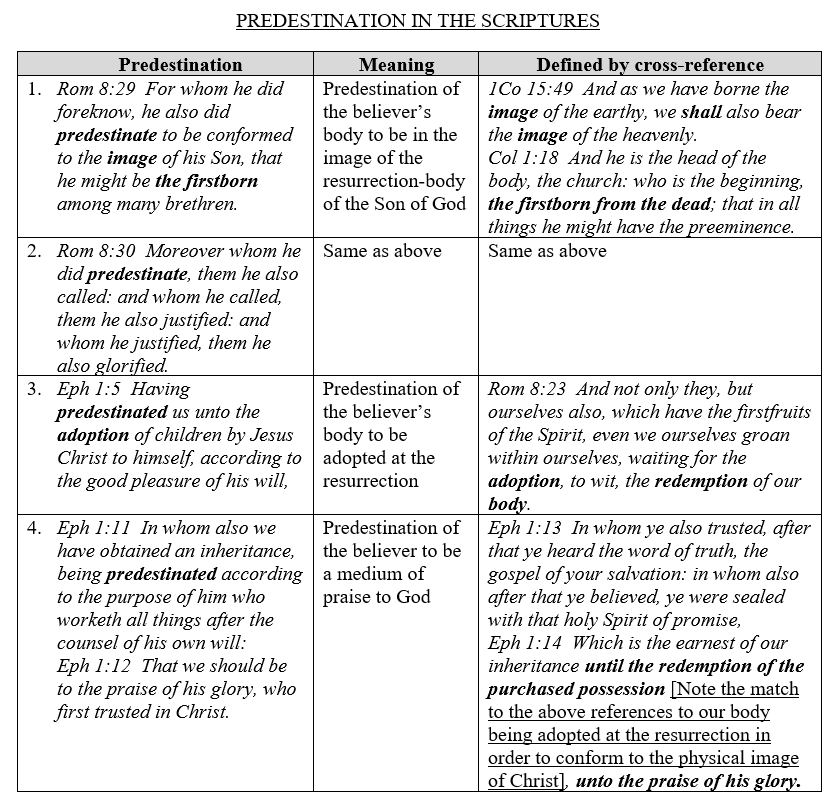
Now the chart
1] It is not just the body image in view.
The image bearer doctrine was not about having a physical body itself,
God is Spirit.
It was Jesus who took upon himself the form of a servant. in the incarnation
2] you ignore that which pertains to salvation
3]adoption has to do with our rights as SonS
From A baptist catechism with Commentary, by WR.Downing-
Quest. 93: What is adoption? Ans: Adoption is an act of God’s free grace, whereby the believer is received into the number, and has a right to all the privileges of the sons of God, including the reception of the Holy Spirit. The full and final realization of adoption awaits the bodily resurrection unto glory.
COMMENTARY The Fatherhood of God is revealed in Scripture in several different filial relationships, none of which must be confused with the others: first, a
182
trinitarian or ontological filial relationship scripturally designated in terms of “Sonship.” The Lord Jesus Christ is God the Son, an ontological, eternal or generational Sonship, which is unique. See Questions 23 and 25. This designation distinguishes the second Person of the triune Godhead from the first and third Persons.
Second, a creational sonship, which includes angelic beings and human beings created by God as rational, moral, self–determining beings. Although all men are the children [“offspring’] of God in a creational sense, as bearing the Divine image (Gen. 1:26; Acts 17:28; Eph. 3:14–15; Jas. 3:9), this does not imply the “universal Fatherhood of God” and the “universal brotherhood of all men.” Such would deny the Fall, its consequences, the reality of sin and the necessity of redemption.
Third, a national sonship, which designated Israel under the Old Covenant (Ex. 4:22– 23; Rom. 9:4, 6–8). Fourth, a redemptive filial relation or sonship. This relationship is grounded in the sovereign love of God the Father (Eph. 1:3–5), through the mediatorial work of the Son (Gal. 4:4–6; Eph. 1:5–7), and evidenced by the ministry and witness of the Holy Spirit (Rom. 5:5; 8:14–17; Gal. 4:4–6). It is inseparable from regeneration and justification, and yet redemptively unique. It is this last sonship to which the biblical doctrine of adoption refers. The English term “adoption” derives from the Latin adoptio (from ad, “to” and opto, “choose”). The term occurs five times in Scripture, all in the New Testament, and all in the writings of Paul: Rom. 8:15, 23; 9:4; Gal. 4:5; Eph. 1:5. The Gk. term is huiothesia, from huios, “son,” and thesis, “a placing,” and literally means “to place as a son,” a process and ceremony upon one’s majority, which referred to natural sons within the family as well as to adopted sons from outside the family. One must take care not to read into the Scriptures either the bare Latin etymology, the legal, or the modern idea of adopting someone into the family as a child. The biblical terminology and its use designate this, but also much more. Adoption, then, is a distinct, forensic, separate and gracious act of God which brings us into that filial relationship and intimacy as his beloved sons and children. It is through adoption that we receive the Holy Spirit and the status of sonship (Rom. 8:14–17; Gal. 4:4–7). This forensic, gracious act of God—separate and distinct from regeneration and justification—stands at the foundation of our filial relationship to God as our Heavenly Father, and inclusively of our whole Christian experience. It is in the context of our adoption that we must consider our Father’s mercy and grace (Eph. 1:3–7; 2:18; 3:14–19), our relationship to him as “Father” (Gal. 4:5–7), our prayers to and communion with him (Matt. 6:9, 14–15; Lk. 11:2), his loving kindness, chastening and providential care (Rom. 8:14–17, 23, 28; Heb. 12:5–14), and that glorious presence, witness, seal and earnest of the Holy Spirit, who makes our Christian experience a reality, retains our glorious inheritance and preserves us unto his heavenly kingdom (Rom. 5:5; 8:15–16; Gal. 4:4–7; Eph. 1:13–14; 4:30; 2 Tim. 4:18; 1 Pet. 1:4).
183
Adoption possesses a vital eschatological aspect. The New Testament associates our final adoption [placing as a son] with our resurrection unto glory. Our resurrected, glorified bodies will signal our full and final status as the sons of God manifested before all creation (Rom. 8:17–23; Phil. 3:20