• Welcome to Baptist Board, a friendly forum to discuss the Baptist Faith in a friendly surrounding.

    Your voice is missing! You will need to register to get access to all the features that our community has to offer.

    We hope to see you as a part of our community soon and God Bless!

Has God Ordained a certain style for Musical worship?

Some Rando

New Member
Reminds me of the time back during the so called Jesus college movement time, before my time, when no doubt many students were getting saved loved to ;listen to George Harrison singing my sweet Lord, but forgot to tune into very end when he told you that Krishna was his lord and savior
I've never heard that. That is both tragically funny and entirely believable. :confused:
 

John of Japan

Well-Known Member
Site Supporter
CCM is a wide genre. It is "Contemporary Christian Music".

Here are a few subcategories:

1. Contemporary Worship Music
2. Christian Rock
3. Christian Country
4. Christian R&B/ Rap
5. Christian Metal
6. Contemporary Gospel
7. Southern Gospel

It seems you are doing something akin to saying "Birds are chicken's because a chicken is a bird". That don't fly ....:Cautious....:Biggrin

I agree Christian Rock is not good music for congregational worship. You mentioned it was subpar (musically) to its secular counterpart. In general, it isn't (at one time, perhaps). Jars of Clay, Switchfoot....these made it in tge secular audience as well (just with Christian lyrics).

By "Contemporary Worship" what is meant is songs that were designed to be sung as a congregation. These are hymns, but with different music.

By "worship" in general I am speaking of giving glory to God (praising God) in all we do.

With music, I believe that it is good to express praise and to do so as a congregation.

I have no clue what "pipious" means, but my phone must.
This is right after the post where I said that country gospel ("Southern Gospel" is part of that genre, developed in the early 20th century) is a lot older than CCM, and should not be included. I have a set of three Singspiration songbooks from the 1960s (no copyright date) with the title, Western Style Songs." They have old country favorites going way back: "The Eastern Gate" (out of copyright), "The Old Account" (same), "Life's Railway to Heaven" (same), "Peace in the Valley" (1939), and many more.
 
Last edited:

JonC

Moderator
Moderator
This is right after the post where I said that country gospel ("Southern Gospel" is part of that genre, developed in the early 20th century) is a lot older than CCM, and should not be included. I have a set of three Singspiration songbooks from the 1960s (no copyright date) with the title, Western Style Songs." They have old country favorites going way back: "The Eastern Gate" (out of copyright), "The Old Account" (same), "Life's Railway to Heaven" (same), "Peace in the Valley" (1939), and many more.
Not Southern Gospel but Chriatian Country (I like Southern Gospel).

Gold City is Southern Gospel. For King and Country is Christian Country.

Southern Gospel is heavily associated with Lawrenceburg TN in the early 1900's and the Janes D Vaughn publishing company (shape note music). They have a neat museum in the square (it is a small town).

@John of Japan

This has been a fun discussion.

Obviously genres overlap. Musicians were influenced by different types of music, styles blended, grew into another category, the category progressed.

I woukd argue, for example, that much of today's country music - by yesterday's ear - is pop or rock. Yesterday's prog rock is more popular now. It is interesting.

I enjoy music as expression, not merely accompaniment. I don't particularly enjoy Classical music, but I like Impressionalism (especially Ravel and Debussy). But Impressionalism grew from Classical.

It is fun to talk about, even though completely unrelated to my point (that music in worship shoud be a genuine expression from the worshipper).
 

John of Japan

Well-Known Member
Site Supporter
@John of Japan

This has been a fun discussion.

Obviously genres overlap. Musicians were influenced by different types of music, styles blended, grew into another category, the category progressed.

I woukd argue, for example, that much of today's country music - by yesterday's ear - is pop or rock. Yesterday's prog rock is more popular now. It is interesting.

I enjoy music as expression, not merely accompaniment. I don't particularly enjoy Classical music, but I like Impressionalism (especially Ravel and Debussy). But Impressionalism grew from Classical.

It is fun to talk about, even though completely unrelated to my point (that music in worship shoud be a genuine expression from the worshipper).
I have to go. Taking first aid lessons for our security team.

Hmm.
 

Attachments

  • 530_cartoon_1.2.jpg
    530_cartoon_1.2.jpg
    114.9 KB · Views: 2

JonC

Moderator
Moderator
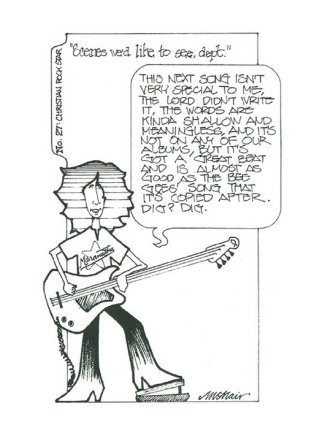
I was trying to find the Babylon Bee one about the song leader who got stuck in the song.

Anyway, the comic is funny but unfortunately untrue.

More Contemporary Worship is more God's Word than hymns. I still love the hymns (the lyrics) but noticed so many of our worship music is directly taken from various Psalms. And many are old hymns set to different music. But yes, contemporary worship musicusually has a chorus. Kinda like hymns....you sing a verse but the chorus repeats.

I only mention this because I don't want people taking the cartoon as anything more than a cartoon based on a stereotype.


Now....Christian Rock is different. Often it is Scripture set to music, but many times it originated from experience (like so many of our hymns). But it is rarely repetitive.
 

John of Japan

Well-Known Member
Site Supporter
I was trying to find the Babylon Bee one about the song leader who got stuck in the song.

Anyway, the comic is funny but unfortunately untrue.
Actually, the comic is very true of any type of music: folk, classical, hymns, CCM, all music (but I meant it just for fun).

You must practice to play well, and the guy in the comic did not. You must think deeply to write the lyrics (are they biblical, helpful, glorifying God?). You must think of the hearer and how they will respond (God, the believers in the pew, the lost sinner).

Story time: in the 1970s I travelled with some guys in my college doing martial arts evangelism (so, well before CCM). We were sitting in the pews of a growing country church for a service in Spotsylvania, VA, when a man and his wife got up for a special number. He strummed his guitar, and his wife said, "George, you need to tune that thing." Actually, it sounded okay to Bobby my buddy and me, and both of us played guitar. George proceeded to tune his guitar out of tune, and Bobby and I were in stiches. Then they said, "Y'all pray for us, 'cause we ain't practiced much." Then they sang the most awful special number we had ever heard. It was a hymn, yes, but awful. Their special number did not glorify God.

There are biblical hymns, and then there are hymns with awful lyrics like "I Come to the Garden Alone." Some of the hymns by holiness writers have theologically poor lyrics. And I could go on.

My problem with this thread is that you never, ever admit anything wrong whatever with CCM. Apparently in your world the words of a CCM song are always biblical, the song always glorifies God (even if you weren't there and don't know what the song was), and the performers always practice well. You refused to admit any problems with a church rock band that caused physical discomfort to visitors. To you, even that glorified God.
 

JonC

Moderator
Moderator
Actually, the comic is very true of any type of music: folk, classical, hymns, CCM, all music (but I meant it just for fun).

You must practice to play well, and the guy in the comic did not. You must think deeply to write the lyrics (are they biblical, helpful, glorifying God?). You must think of the hearer and how they will respond (God, the believers in the pew, the lost sinner).

Story time: in the 1970s I travelled with some guys in my college doing martial arts evangelism (so, well before CCM). We were sitting in the pews of a growing country church for a service in Spotsylvania, VA, when a man and his wife got up for a special number. He strummed his guitar, and his wife said, "George, you need to tune that thing." Actually, it sounded okay to Bobby my buddy and me, and both of us played guitar. George proceeded to tune his guitar out of tune, and Bobby and I were in stiches. Then they said, "Y'all pray for us, 'cause we ain't practiced much." Then they sang the most awful special number we had ever heard. It was a hymn, yes, but awful. Their special number did not glorify God.

There are biblical hymns, and then there are hymns with awful lyrics like "I Come to the Garden Alone." Some of the hymns by holiness writers have theologically poor lyrics. And I could go on.

My problem with this thread is that you never, ever admit anything wrong whatever with CCM. Apparently in your world the words of a CCM song are always biblical, the song always glorifies God (even if you weren't there and don't know what the song was), and the performers always practice well. You refused to admit any problems with a church rock band that caused physical discomfort to visitors. To you, even that glorified God.
I actually don't mind "In the Garden". As a kid I never got the part where "He bids me go". It wasn't until I realized Miles had written it about Mary seeing the resurrected Jesus (John 20:11-18) that it made sense to me. I kinda like it now.

Obe of the best songs (I actually can't remember the song) was from a 95+ year old man. I can't say it sounded good, but I have to admit God was glorified in the man's worship.

Anyway, this is what I was trying to find....and finally did:


John of Japan

Well-Known Member
Site Supporter
Not conforming to the world is a key criterion for discerning what kinds of instrumental music are acceptable to God for use in corporate worship.
I completely agree.
I actually don't mind "In the Garden". As a kid I never got the part where "He bids me go". It wasn't until I realized Miles had written it about Mary seeing the resurrected Jesus (John 20:11-18) that it made sense to me. I kinda like it now.

Obe of the best songs (I actually can't remember the song) was from a 95+ year old man. I can't say it sounded good, but I have to admit God was glorified in the man's worship.

Anyway, this is what I was trying to find....and finally did:

You have to love the Babylon Bee.
 

JonC

Moderator
Moderator
Not conforming to the world is a key criterion for discerning what kinds of instrumental music are acceptable to God for use in corporate worship.
Depends on what you mean.

Is using a paino conforming to the world because the instrument was not designed specifically for worship music? Obviously not. It isn't instruments.

But maybe it is how they are played. Is adopting the music of the world...like "What Child is This?", "Glorious Things of Thee are Spoken", "Christ the Lord is Risen Today" did conforming to the world? Maybe. They used secular music.

But then again, our older traditional hymns used music that were modeled after bar tunes because they were easy to sing.

Here Contemporary Worship music has an advantage over hymns.

While instruments that are used in secular music (like a paino, guitar, drums) are often used in contemporary worship the music itself is set apart from the music of the world (unlike hymns in relation to the music when they were written).

Nobody would hear a contemporary worship song without any lyrics and think that is the type of music the world is listening to. It is distinctinct, not like the music sung in bars that inspired the music of traditional hymns.

That said, I do not believe that hymns are wrong because the music was secular at the time. The common ground with contemporary worship music is they are singable and biblical. So I say, sing your hymns without guilt. If you can't then for conscious sake change to contemporary worship.

Now....Christian Rock, Christian country, Christian rap....thats another story....but those have another purpose.

You have to love the Babylon Bee.
Yea...that one is my favorite one.

And I would consider that a real objection and maybe the soundest objection to it.
The question has to be asked: Even if a Rock song has incredibly great lyrics, if they are unintelligible (at least to many) are they then not particularly edifying?

Mind you, I loathed this objection as a youngster when the fuddy-duddies asked it, and to be fair, they might often have used that objection simply because they personally disliked it and not asked it in good faith (if you take my meaning). However, I must admit that it is a real objection that raises meaningful questions.
I think that there is a distinction between Contemporary Worship music and other types of CCM (like Christian Rock, Christian Rap, etc.).

Christian Worship music is designed to be sung (I doubt anybody woukd have a hard time understanding the lyrics). The accompanying music is fairly simplistic (and simple to play).

This was the reason that hymns used secular music of their time, or modeled their music on songs sung in taverns. They were easily sung.

The rest of CCM is both Christian entertainment and evangelism (like Christian movies and TV shows), but to people who listen to that type of music. My son listens to Christian rap-hip hop. I can't understand a word. He can.


In other words, I get why people who do not like rap would mot like Christian rap. Same with any other type of music.

I do not quite get the objection to Contemporary Worship music, especially given the origins of the music that accompany traditional hymns. It seems hypocritical.

How can somebody sing a hymn set to a secular English song, or modled off of tavern songs, and complain about the music accompanying Contemporary Worship music being too secular (especially when it sounds nothing like secular music)?
 
Last edited:

John of Japan

Well-Known Member
Site Supporter
I think that there is a distinction between Contemporary Worship music and other types of CCM (like Christian Rock, Christian Rap, etc.).

Christian Worship music is designed to be sung (I doubt anybody woukd have a hard time understanding the lyrics). The accompanying music is fairly simplistic (and simple to play).

This was the reason that hymns used secular music of their time, or modeled their music on songs sung in taverns. They were easily sung.
This is a complete myth. You cannot name a single hymn that came from a tavern song.

Here is an essay about this accusation against the Wesleys by someone who did the research you could have done: Wesleys' Tavern Songs

Here is another about the charge that Luther used drinking songs: Which Of Our Favorite Hymns Are Rewritten "bar" Songs?

We do have Christian music from folk songs, however: "I Have Decided" (India), "What Child Is This" (England), etc.

Look through a hymnbook. Every song has the author of the music on the left and the author of the tune on the right. In an appendix in many hymnbooks you can find the sources for many hymns. You will look forever and not find a single tavern source. Instead, you will find great hymnwriters like Charles Gabriel (traveled with the great evangelists), P. P. Bliss (traveled with Moody), John W. Peterson, and Alfred B. Smith (a friend of my grandfather who I have met). Even the great "We Shall Overcome" was patterned after a hymn written by a faithful black pastor named Charles Albert Tindley whose son Elbert was a great singer--traveled with my grandfather for years.

In fact, believe it or not, I wrote a song myself that is in a Japanese hymnbook, and it was not from a tavern song.
 

Attachments

  • What Will Happen Now.pdf
    61.5 KB · Views: 1
Last edited:

John of Japan

Well-Known Member
Site Supporter
Folks, I consider John W. Peterson (1921-2006) to be the greatest hymnwriter of the 20th century. Here is a website devoted to honoring him: John W. Peterson Music: Welcome

He wrote so many great songs of all kinds--except CCM I'm sure. ;) And almost always he wrote both words and music.
 
Last edited:

JonC

Moderator
Moderator
But at the same time consider that the style of music accompanying traditional hymns originated from tavern and folk songs. ;)

This is a complete myth. You cannot name a single hymn that came from a tavern song.

Here is an essay about this accusation against the Wesleys by someone who did the research you could have done: Wesleys' Tavern Songs

Here is another about the charge that Luther used drinking songs: Which Of Our Favorite Hymns Are Rewritten "bar" Songs?

We do have Christian music from folk songs, however: "I Have Decided" (India), "What Child Is This" (England), etc.

Look through a hymnbook. Every song has the author of the music on the left and the author of the tune on the right. In an appendix in many hymnbooks you can find the sources for many hymns. You will look forever and not find a single tavern source. Instead, you will find great hymnwriters like Charles Gabriel (traveled with the great evangelists), P. P. Bliss (traveled with Moody), John W. Peterson, and Alfred B. Smith (a friend of my grandfather who I have met). Even the great "We Shall Overcome" was patterned after a hymn written by a faithful black pastor named Charles Albert Tindley whose son Elbert was a great singer--traveled with my grandfather for years.

In fact, believe it or not, I wrote a song myself that is in a Japanese hymnbook, and it was not from a tavern song.
Yes, I can. But by tavern songs I dont mean merely drinking music. I mean folk songs often sung in taverns.
Greensleeves was a tavern (and folk) song. Some think Lady Green Sleeves was a prostitute, others just a woman, but it was a tavern song before accompanying a hymn.

BUT @John of Japan , you had me for a moment. I almost didn't catch the change you made.

I did not say they used drinking songs, or tavern songs. I said they used the style. I was thinking about Luther, not because of reading he did but because German tavern and folk music is the same type used in Luther's hymns.

You could put Christian lyrics to Es führt über den Main (secular music from early 1900's) and it'd fit right in your hymnal.

Hymns used the same type of music for a reason. They are easily sung and played (unless you choose to get fancy).

Nobody sat around in the 16th century thinking of a way to invent a new type of sacred Western music. They simply wrote and sung to praise God.

I reject the idea that Christians should condemn the praise of those in remote areas because their worship music is too country, or bluegrass. And I reject the idea people shoukd condemn the worship of others because they sing hymns to more contemporary music. I also reject condemning the worship of those who prefer those hymns, which used a secular style no longer popular.

Here is an example of what I am talking about.

This is a popular secular tune from the early 1900's


Secular song popular in English taverns (first time in orintvwas 1580):


Secular song 1906

 
Top